• Skip to primary navigation
  • Skip to main content
  • Skip to primary sidebar

Australia Awaken - ignite your torches

Narratives from Down Under

  • First Light
  • Awards
  • Budget
  • Employment
  • Race
  • Refugees
  • Political
  • Sex
  • Taxes
  • Voting
  • Women.
  • Login & Msgs

James J. Morrison W.G. Dupree

A Climate of Opinion.

December 6, 2018 by James J. Morrison W.G. Dupree 1 Comment

The battle for climate change mitigation is euphemistically referred to as a “debate” amidst ideologically restrained political advocates that still think there are legitimate oppositional interpretations about it, to respect.

Even the youngest of students could understand the implications.

When opinions replace facts in a “post-truth” world, the result may be that confusion and ideology reign inappropriately in society. The increasing occurrence amidst western nations of the populist right, fascism and the rejection of science have manifest to generate a new dark age. Climate change denialists champions include Donald Trump (USA), Jair Bolsonaro (Brazil), Recep Erdoğan (Turkey), – and further down the list – Scott Morrison (Australia).

The Sea of Opinions

Like fish swimming in the water, human social exchange swims in a sea of opinions. Facebook, Twitter and online commentary in the news media are awash with a flood of emotionally charged views fought with passionate debates, justifying links, populist rhetoric and ad hominems. The truth may emerge but catching glimmers of it, is as elusive as panning for gold.

The other day after some back and forwards over the subject of immigration my temporary antagonist finally resorted to “I think we have to agree to disagree on this one.” At which point I replied, “We do indeed” and more or less left the conversation with him. (Aside from an amusing sideline with a close friend of my antagonist who made some wry observations of him.) It fell into a case of a civil agreement, to disagree. Isn’t it all just a matter of opinion?

The Olive Curse

Well no. For example, my wife loves olives, and I hate them. It’s my opinion that olives are a curse rendered on humanity by unkind gods sent to torture one’s palate.  My belief about olives is a matter of opinion. The only consequence is when I get a salad with olives, I pass them to my wife’s plate.  She thinks they are a blessing that I am prepared to fork over, whenever I encounter them. Apart from our culinary differences, there are many other times opinions matter and have more serious consequences.

Schools Strike

The sheer crowds of children at the climate protest that my son was delighted to discover.

I spent the afternoon of Friday the 30th of November with my son at the #StrikeForClimate protest in the city. My son – after canvassing his schoolmates who were unaware of the rally – was worried that hardly anyone would turn up. When we turned the corner from George St into Martin place, I pointed up at the massive crowds of thousands of kids and said, “Have a look, you think no one is turning up now?”. He muttered something incomprehensible, but I noted the smile emerging on his face.

Sequence of events

There are opinions that climate change is a natural cycle of events for which humans bears no responsibility. Other opinions blame humankind’s waste and dirty extractive industries. Unfortunately, the opinions have vastly significant consequences, not the least of which may be the end of civilisation as we know it. Dramatic, yes, but the sequences of the events have already begun.
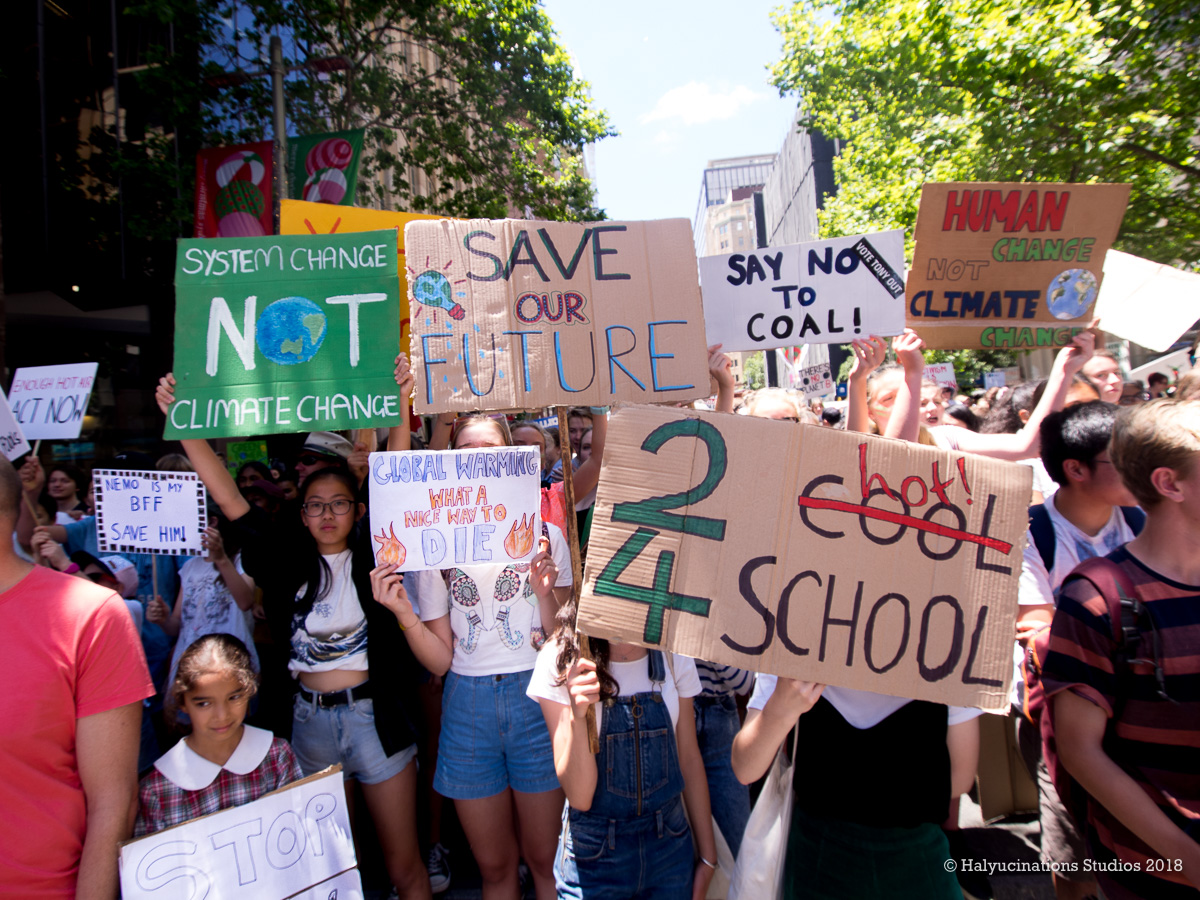
The prospect of a dire and hot future motivates science educated
The prospect of a dire and hot future motivates science educated children

As temperatures rocket and “hottest on record” becomes a catchphrase,

  • coastal regions are swamped,
  • agricultural crops fail,
  • food shortages escalate,
  • numbers of climate refugees swell,
  • plant, insect and animal life permanently migrate,
  • consequential diseases emerge in areas never encountered before,
  • and the health and welfare of the planet’s human inhabitants are endangered.
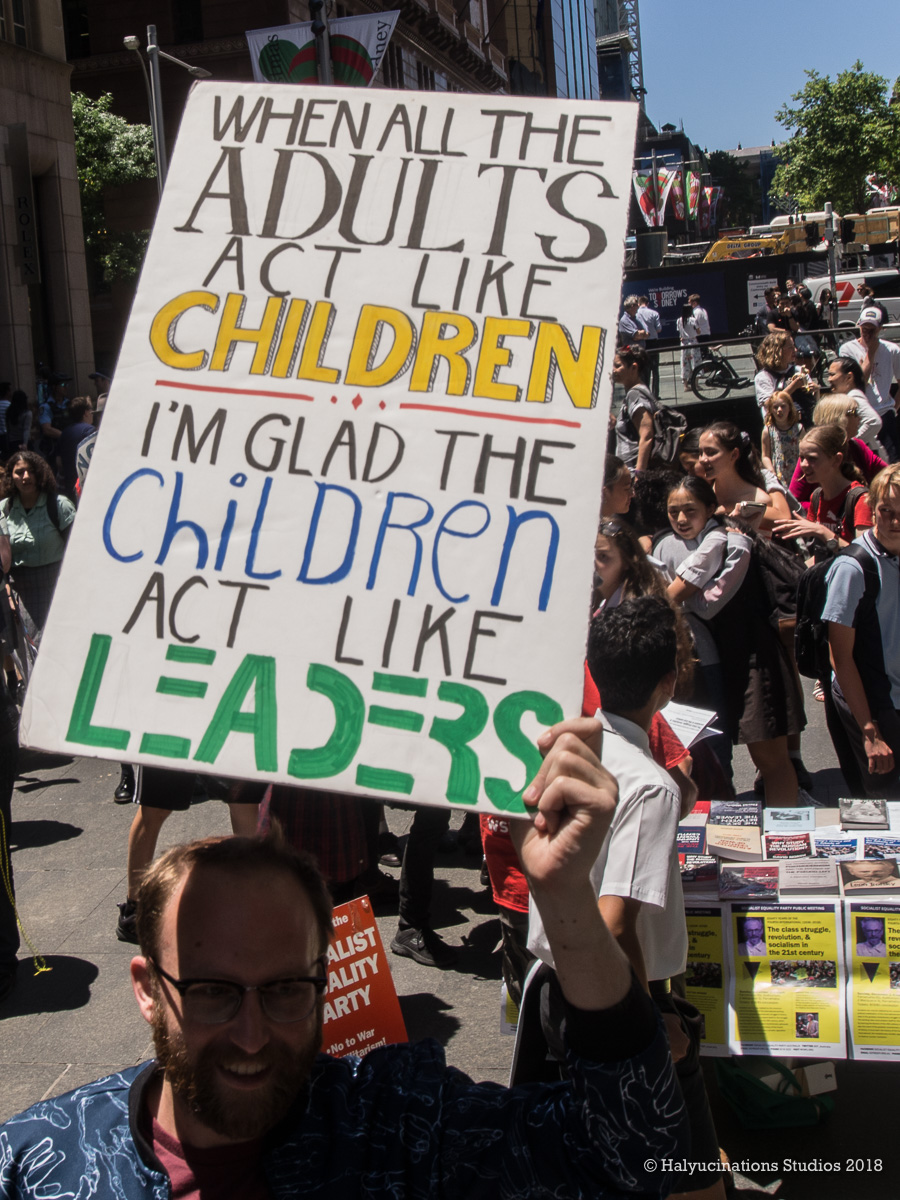
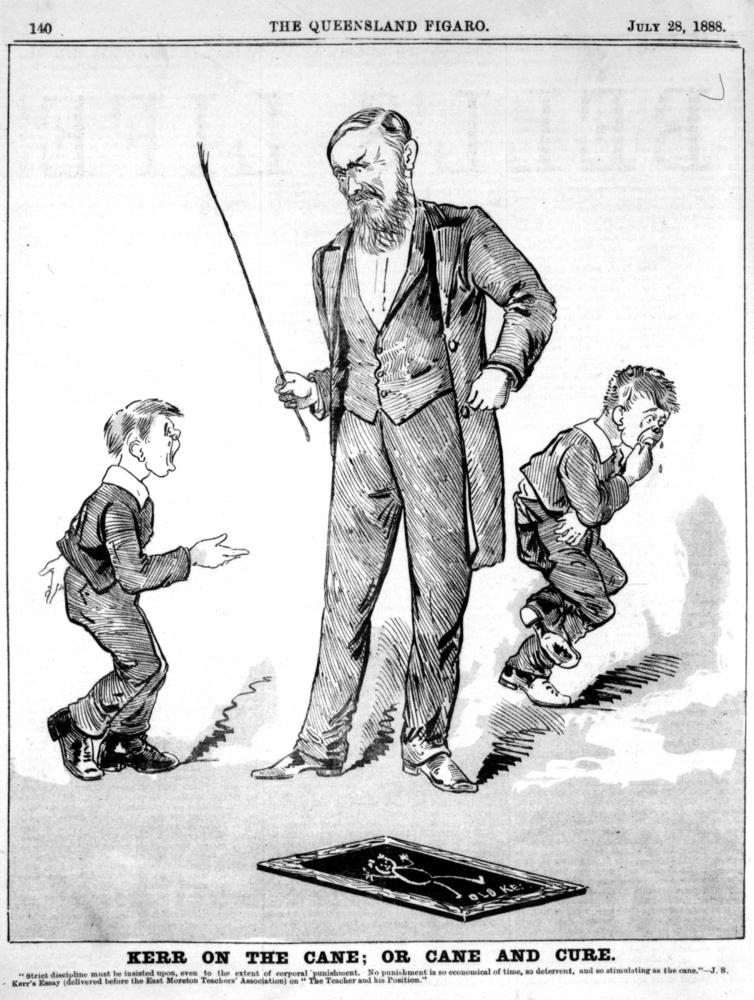
Role reversal is hard when one has to ask children to step up into the role adults should occupy.

Another opinion such as Scott Morrison’s idea that climate change is “nonsense”  fly in the face of concerns by other nations.  If Morrison’s scepticism were true, would mean there is nothing we can do about stopping climate change. If Morrison’s opinions are false, then there is everything that we can do to stop it.
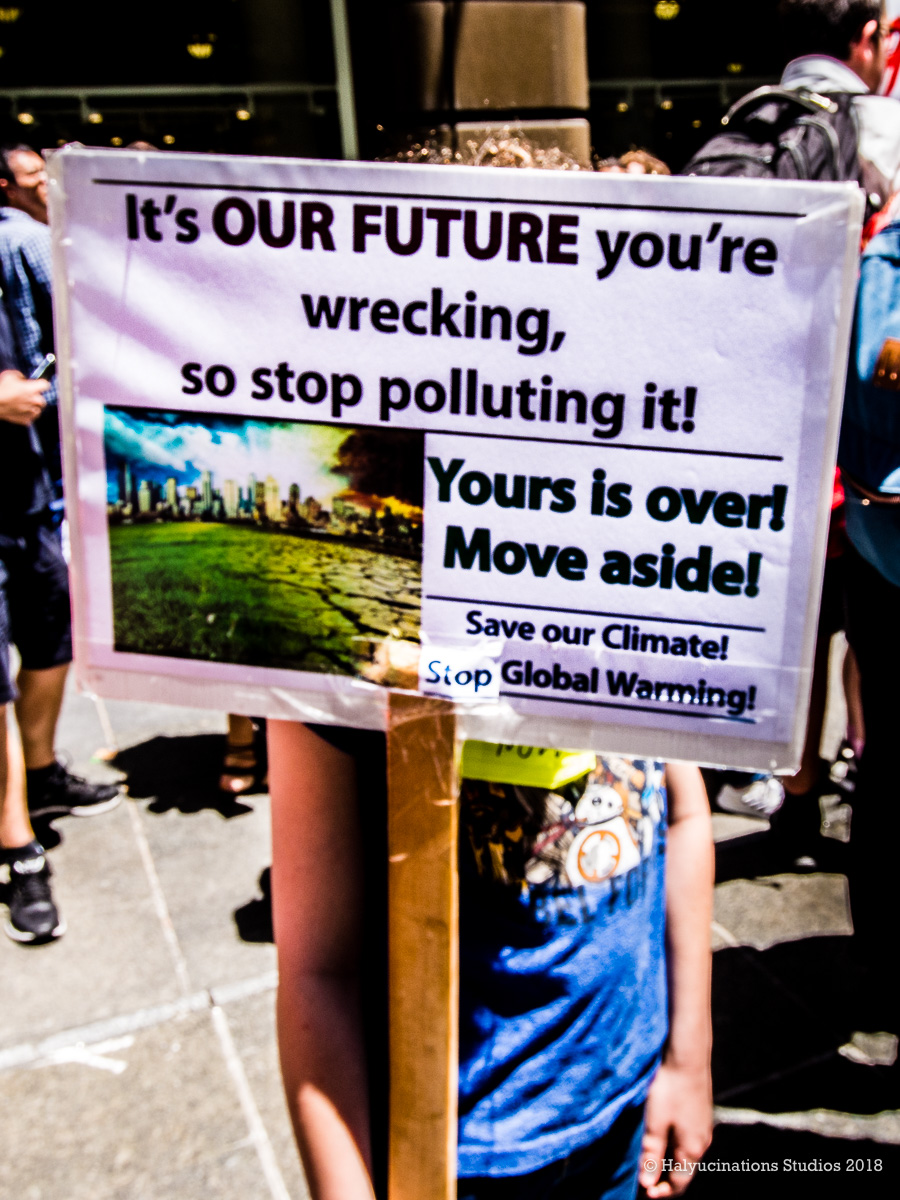
Some signs simply had attitudes of discontent with the status quo.

So these sorts of opinions matter enormously. In these cases, you don’t have a right to your personal opinion divorced from truth, if the fate of the entire world hangs in the balance. Especially if your erroneous view affects what actions we take. As indeed it does in the case of the conservative government who are beholden to wealthy extractive industry leaders who financially support their opinions to profit in the short-term. When my late (small-l liberal) father argued against anthropomorphic climate change with me, I asked him, “On what planet is it a good thing to pollute your environment?” While he conceded the point, there is always the sense of condescension that the older folk have to the previous generation. None so apparent as the criticism of young people skipping school.  They were castigated by politicians before their protest over the lack of climate change mitigation had even begun.

Follow the History & Money

Despite this, our children took to the streets around the nation in protest of the destruction of their future. They have no ties to corporate ideology nor are they being paid off by extractive industry donations.

Exxon's own scientific research from 40 years ago has only confirmed what we still know today.
Exxon’s own scientific research from 40 years ago has only confirmed what we still know today.

It is a truth that the extractive industries knew about the problems with CO2 and overheating the planet for decades. The extractive industries were predicting the effects of industrial pollutions effects on heating our climate in the 1980s. Despite years of research and technology advances and scrutiny over 40 years, our scientific research has done nothing else but confirm what Shell and Exxon knew and then actively falsely denied.

So it is way past time we had our kids still shouting about it in the streets. There is nothing temporary or theoretical about the findings: these have been confirmed! We should have legislated against polluting industries decades ago. Our failure to commit to climate change mitigation should be a criminal offence!

Remember Tobacco?

Who is smarter than whom and who are the "adults" in this battle.
Who is smarter than whom and who are the “adults” in this battle.

This resistance is hardly the first or last battle the scientific community will have with uneducated or compromised opinions. Who recalls a very similar “debate” over whether or not, smoking causes cancer? US tobacco companies were well aware of tobacco’s effects on health, in the same manner, Exxon was about climate change but denied it publically for years. These companies fought every attempt to speak the truth. It is only in the last few years that these companies have been dragged kicking and screaming into public self-confession. As the truth has diminished their market,  Tobacco companies are moving into new smoking markets as Altria is in talks to buy the Cronos group.  Therein lies new issues for another discussion.

Vaccinations have saved lives and eradicated entire diseases from the spectrum of deadly and disabling ailments on this planet.  Yet, the anti-science brigade of anti-vaxxes that have a long history of obstinate rejection is expressing opinions which threaten the safety of the greater community and again, our children.

Your right to an opinion
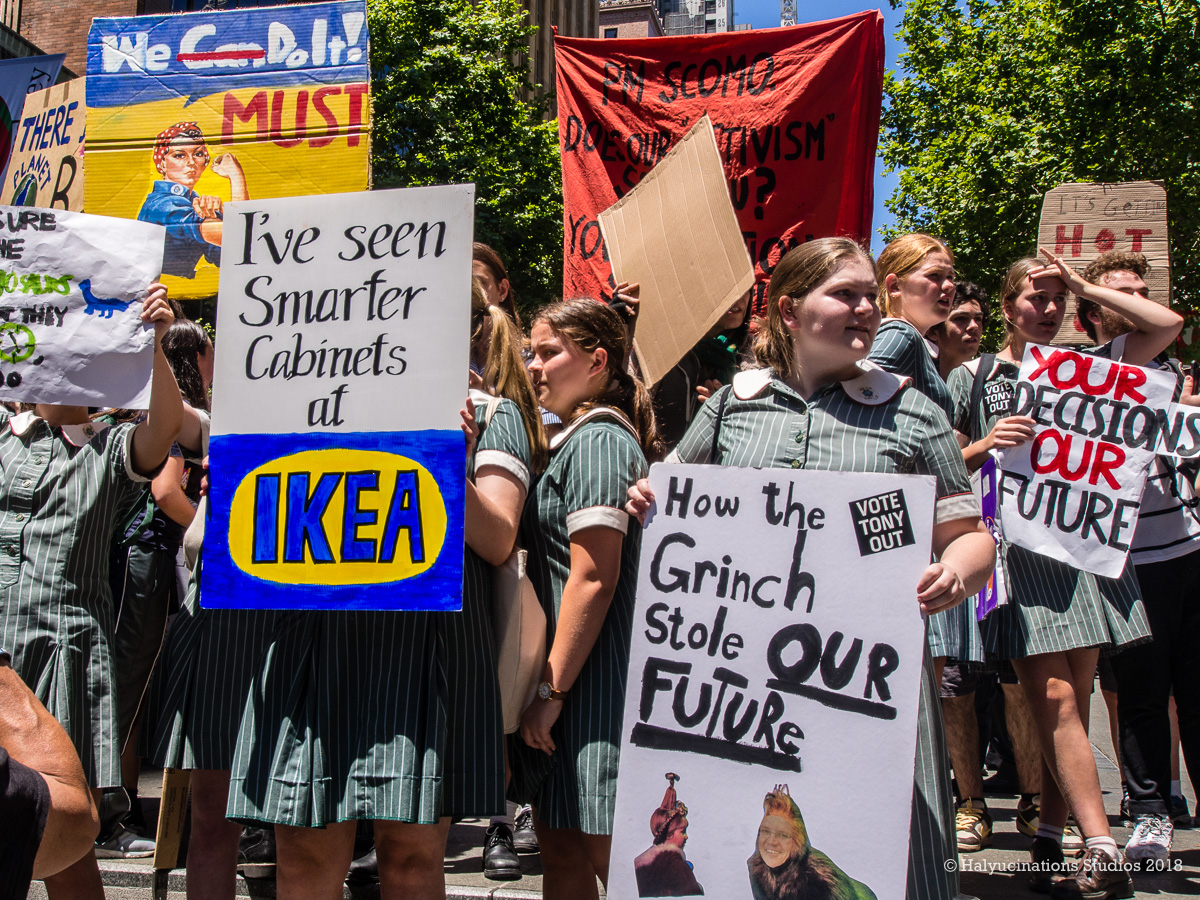
Intelligence is often not a product of age and neither is the getting of wisdom.

If your opinion doesn’t align with the reality, then you need to get the hell out of the way.  I would argue that you don’t have a right to hold that opinion and prevent necessary risk mitigation that is going to save lives. Unfortunately, this is what our errant government is doing, and which our kids stood up to be counted, in opposition on Friday. When it is the children (not the adults) in the US, who are the ones standing up to archaic gun laws because they are averse to being killed, what does this say of the older generation? Similarly, it is children in Australia, that dare to stand up and protest because they too want a future beyond the lifetime of greedy, corrupt old men who want to die rich. Who are the Adults now?
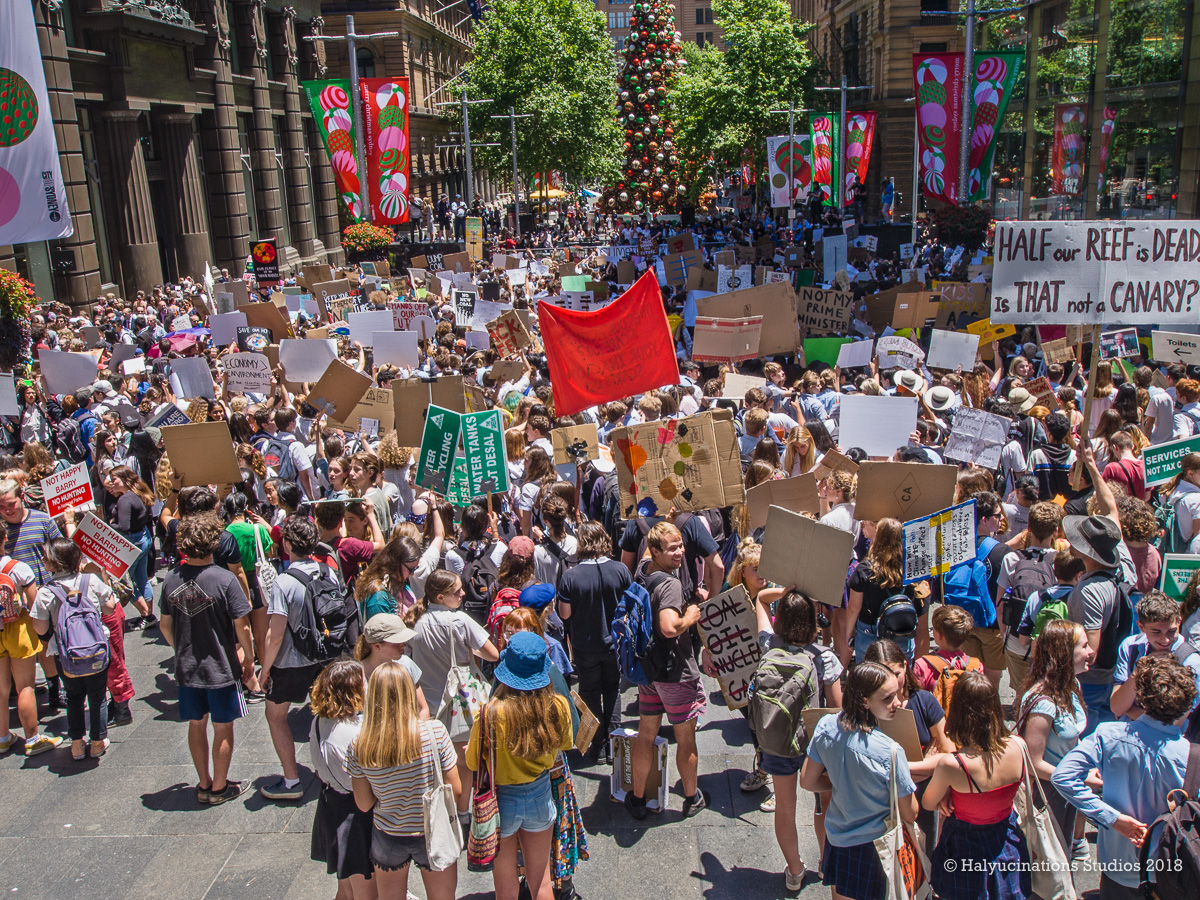
And my son was afraid noone might turn up at the protest.
And my son was afraid no one might turn up at the protest.

So no, there are times when you don’t have a right to your opinion and the current race to save humanity from climate change is one of those times. It is – on the other hand – way past time, to stand up and be counted.
Filed Under: Environment

Comparative corruption and transparency

November 30, 2018 by James J. Morrison W.G. Dupree Leave a Comment

The media and public’s desire for a Federal anti-corruption body and the search for revealing transparency has met with a lagging response by the government. From the mantra of “on water matters” when resisting transparency around refugee issues to the failure to submit Peter Dutton to the High Court over his extraordinary profiting from the public purse, the lack of transparency is wearing thin with the public. As the media scrutiny digs deep into the hidden recesses of the largess to ministers provided by government coffers, the public is finding their protests about the “double dipping” of mothers or the “lifters and leaners” or justification of “Robo debt” claims, a tad hypocritical.

The years of shielding the banks from the scrutiny of what the royal commission has revealed, while these same banks donated millions over time to their political coffers, has upset the public. Especialy as they have often been the victims of these banking scams. That successive prime ministers wanted to offer millions in tax welfare as a gratuitous icing on the cake above and beyond protecting them from their crimes, was seen as very “rich”.

That Morrison could claim that he was unaware of the long history of banking fraud and money laundering or saw it as nothing more than a “populist whinge“, flies in the face of what banks have been seen to do here and across the globe. Repeated inquiries into the banks from the Wallis inquiry in 1997 to the Murray inquiry in 2015 and the equally numerous scandals from merely this century, from NAB concealing losses in 2004 to CommInsure payments scandal in 2016, have demonstrated clearly that unregulated banks will always misbehave. There was never any legitimate grounds for not having a Royal Commission, but the government resistance was palpable. As with most cases of corruption and graft to be found in Banks, isn’t it always recommended that one “follow the money”?

Meanwhile in Denmark

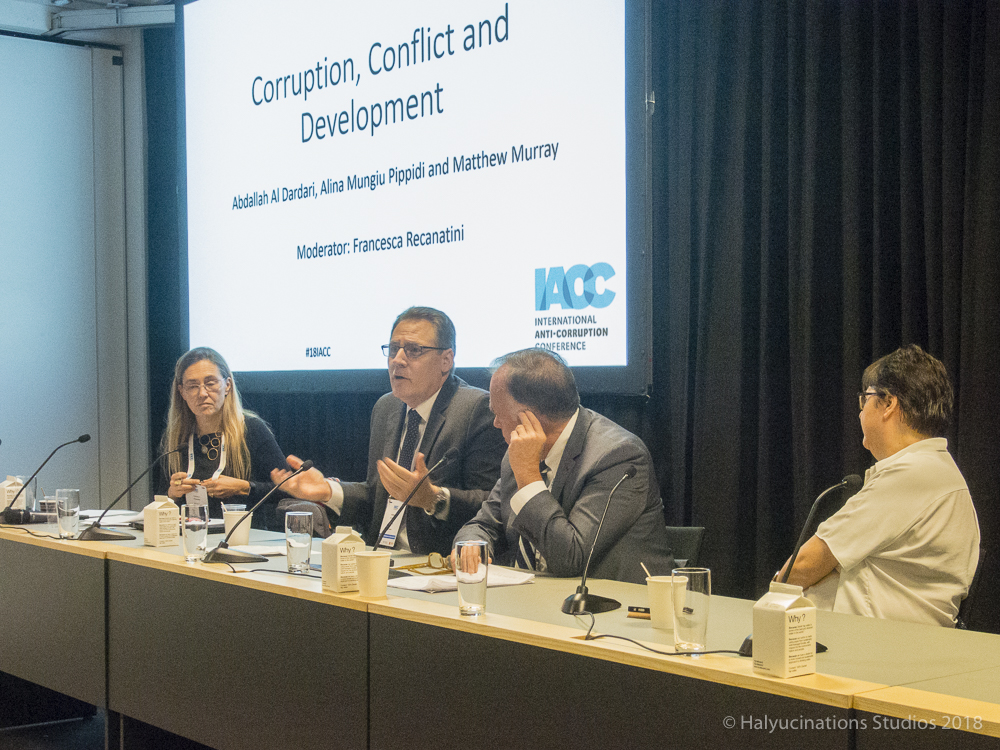
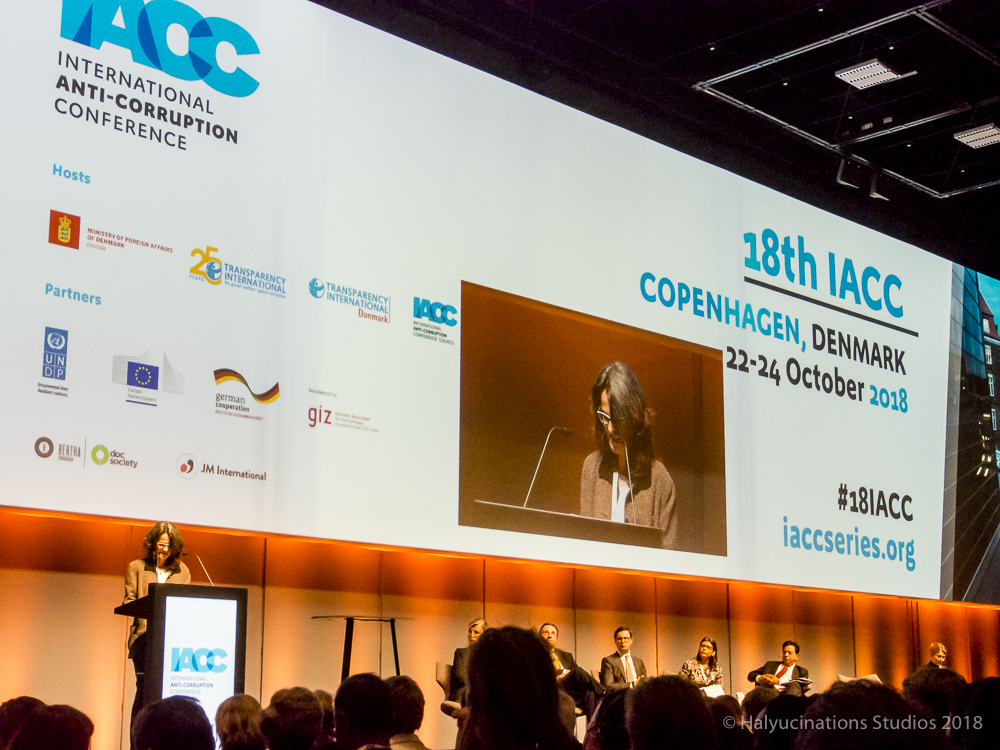
Opening of IACC conference in Bella Centre's Congress
The opening of IACC conference in Bella Centre’s Congress Hall in Copenhagen, Denmark

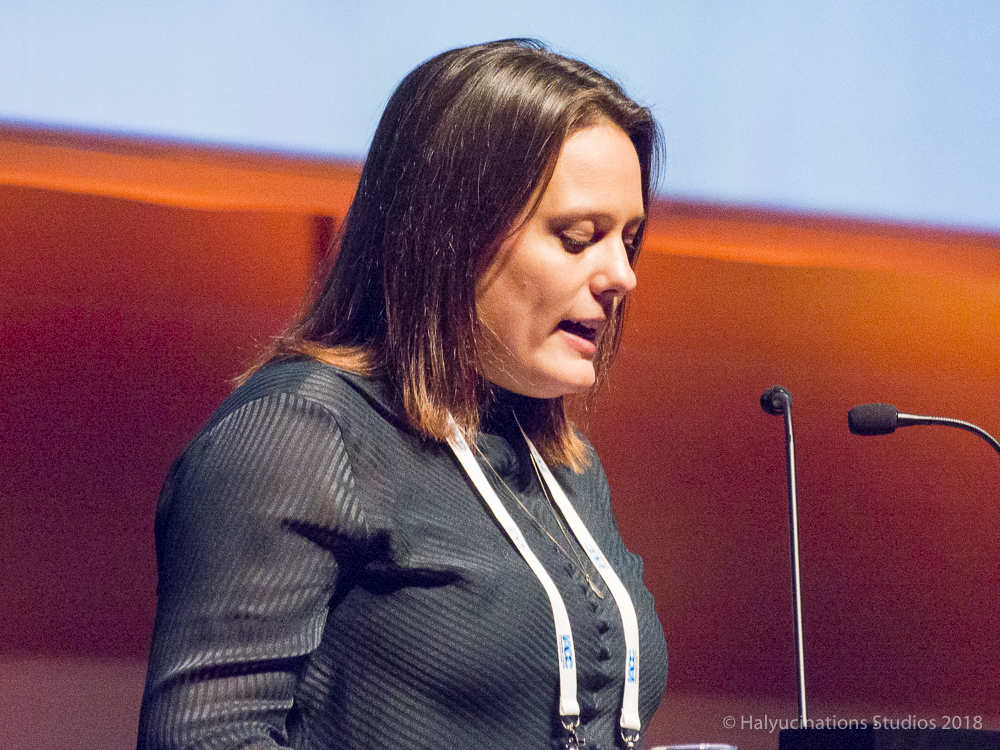
On the international scale, one has only to look at the Danish Banks in a country routinely near the top of the Transparency International index. As the Danish government hosted the International Anti-Corruption Conference (IACC) in Copenhagen on the 22nd of October 2018, the scandal of the Danske Bank was prevalent in the media. The national Danish Chair of Transparency International, Natascha Felix, welcomed the collective audience to three days of workshops and discussion groups. She spoke specifically of the failure of control systems that “allows individuals to steal from the most vulnerable populations in Denmark” and how a Danish bank laundered millions of dollars. The rather ironic timing of Denmark holding this conference and their banking scandal was a subject that came up many times in the course of discussions that followed. The illusion that Denmark was immune to the sin of corruption because of its view that it was an isolated island of progressive values, had been dealt a significant blow. Natascha Felix noted that while Denmark had often been at the top of the Transparency International index, “it doesn’t mean that power and access doesn’t corrupt the Danes.”

Natascha Linn Felix presenting at the opening of the 18th IACC

One of Natascha’s important opening points was that “when it comes to corruption there is so much more at play than rules and regulations and procedures”. For example, locking people in German gulags in the mid-1940s was legal whereas smuggling Jewish people out of Germany was illegal. In a contemporary example, locking up asylum seekers – who have no criminal charges laid against them – in gulags has been legal for years in Australia. Current illegalities have echoes of the German past. When even so much as reporting crimes committed against “legally innocent people” while working in these gulags, is illegal, the roles of values and ethics that transcend laws of convenience are significant.  Corruption and oppression championed by poorly drafted laws and regulations, does not make the actions of governments less corrupt.

Australia’s Fall.

Abdullah Al Dardari answering questions in the Conflict and Development workshop,

Australia held the enviable position of being 7th in the world in the Transparency index in 2013, but since the coalition government has been in power, we have dropped to 13th. This is still an enviable position, especially after I was confronted by a response about that fall, by the former Syrian Minister, Abdullah Al Dardari. While on a panel in a workshop at the IACC conference, he gave an amused response to my query about how Australia should proceed. “I will take Australia at any time now … this is a different planet, what you are talking about … 13th, [we’ve] never been 150th”. While many in the audience laughed, context on the international scale can be quite sobering. (Just in case you were curious, Syria comes at 178th, so you can see why the ex-minister suggested my concerns were “from another planet”.) Still, we are not without our battles to seek better from our governments regarding transparency and the absence of corruption.

As Denmark and our own experience demonstrate, being amidst the top end of the transparency index doesn’t mean our governments and banks and institutions will not make every effort to “rob you blind” and quite literally, “rob the dead”.

What we may never of heard.

Corruption still holds sway in robust democracies with independent judicial and media oversight. Were we in Syria, it is unlikely we would even hear of banking scandals, much less have any official inquiries. Nor might we have heard that Peter Dutton made $5.63 million from direct subsidisation of his childcare facilities for which he voted. Perhaps it didn’t occur to him there was a conflict of interest? Nor might we have heard of his submission to build a third childcare unit, which is a remarkable interest in children despite his ongoing and robust resistance to other children in his care receiving medical care. Perhaps his interest is not the children, one might speculate?

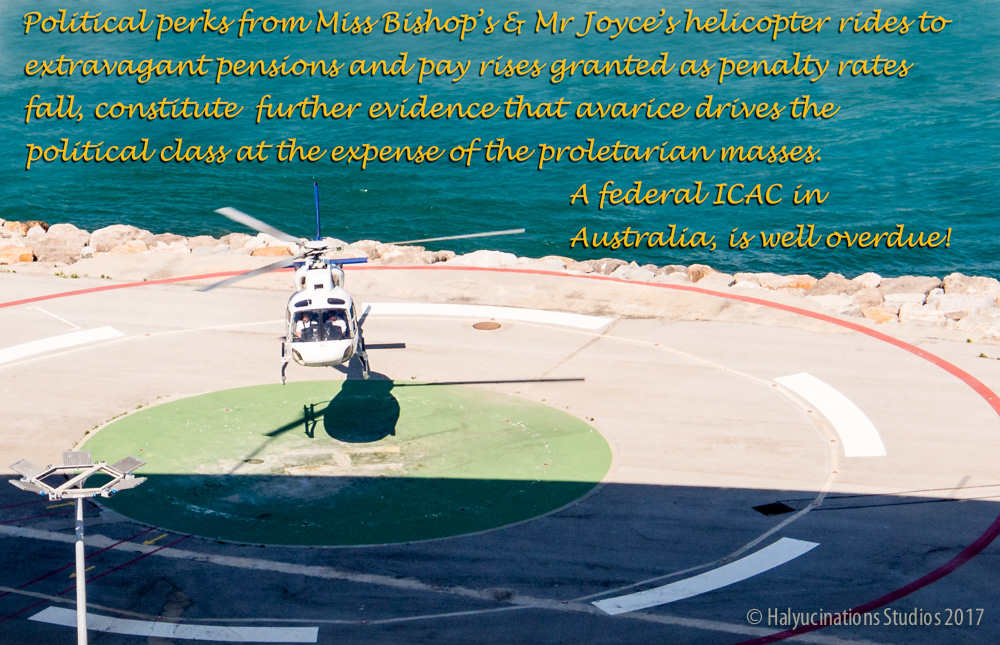
Helicopter scandals, perks & privileges should face ICAC

Nor might we hear about:

  • Bronwyn Bishop’s questionable use of helicopters;
  • The $443 million been given to six people in a laughably named group called the “Barrier Reef Foundation” to get rid of money that might jeopardise an “on paper” budget surplus proposal;
  • Tony Abbott’s enormous expenses claims, or just about any politician’s expenses nowadays;
  • Susan Ley’s coincidental and very rapid decisions on the purchase of Goldcoast property while funded by parliamentary travel entitlements;
  • Assistant treasurer, Stuart Robert’s family company, in receipts of 356 government contracts worth more than $37 million;
  • Or again, Stuart Robert’s elephantine internet bills;
  • David Gillespie’s postal office profits which were the subject of an unsuccessful reference by Labor to the High Court.

I am stopping here although I am sure dear reader you can find many more.

Whereas attempts to pork barrel electorates whether it be Barnaby Joyce or a Wentworth by-election will always receive high publicity under any regime as long as it was positive and complimentary. Negative stories like Joyce’s condemnation of women to cervical cancer deaths would, of course, be wholly suppressed where less robust protections for journalists exist.

We are not Sryia, but…

Corruption is multifaceted and has high-level impacts of any country, and even if we are not the worst, we are infected by its influence.

So we are not Syria. We do hear of, or have a public reaction to, and legal stoushes over, the apparent corrupt conduct of our political leaders, banks and institutions. And with respect to Abdullah Al Dardari’s entirely appropriate observation that we in Australia are “on a different planet”, compared to what he has had to battle in his roles in Syria and later the United Nations, it is a fight none of us should relinquish because there are darker shades of grey. To have fallen to 7th to 13th on the international transparency index – although to over a hundred other nations that is still enviable – it is indicative of a systematic weakening of our democracy. We are on a downward track which our government is responsible for, as are we who do not hold them accountable. We are a lucky country compared to so many, and ours is an elevated state we have taken for granted. For a long time, we’ve remained politically disengaged, proud of apolitical inclinations, unwilling to take stand over the dinner table on behalf of the struggle of others, lest we offend our privileged white neighbours. We have paid scant attention to the slippage that once it gains momentum, will career downwards unless we put our backs against our pedestal and push hard.

Filed Under: Politicians, Refugees

Climate Recalcitrance

October 11, 2018 by James J. Morrison W.G. Dupree Leave a Comment

“Recalcitrant” is what Prime minister Keating once described Malaysian prime minister Dr Mahathir over economic considerations with APEC. In this century, “recalcitrance” has become a term more readily applied to the current persistently pro-coal conservative Government over issues of ecology.

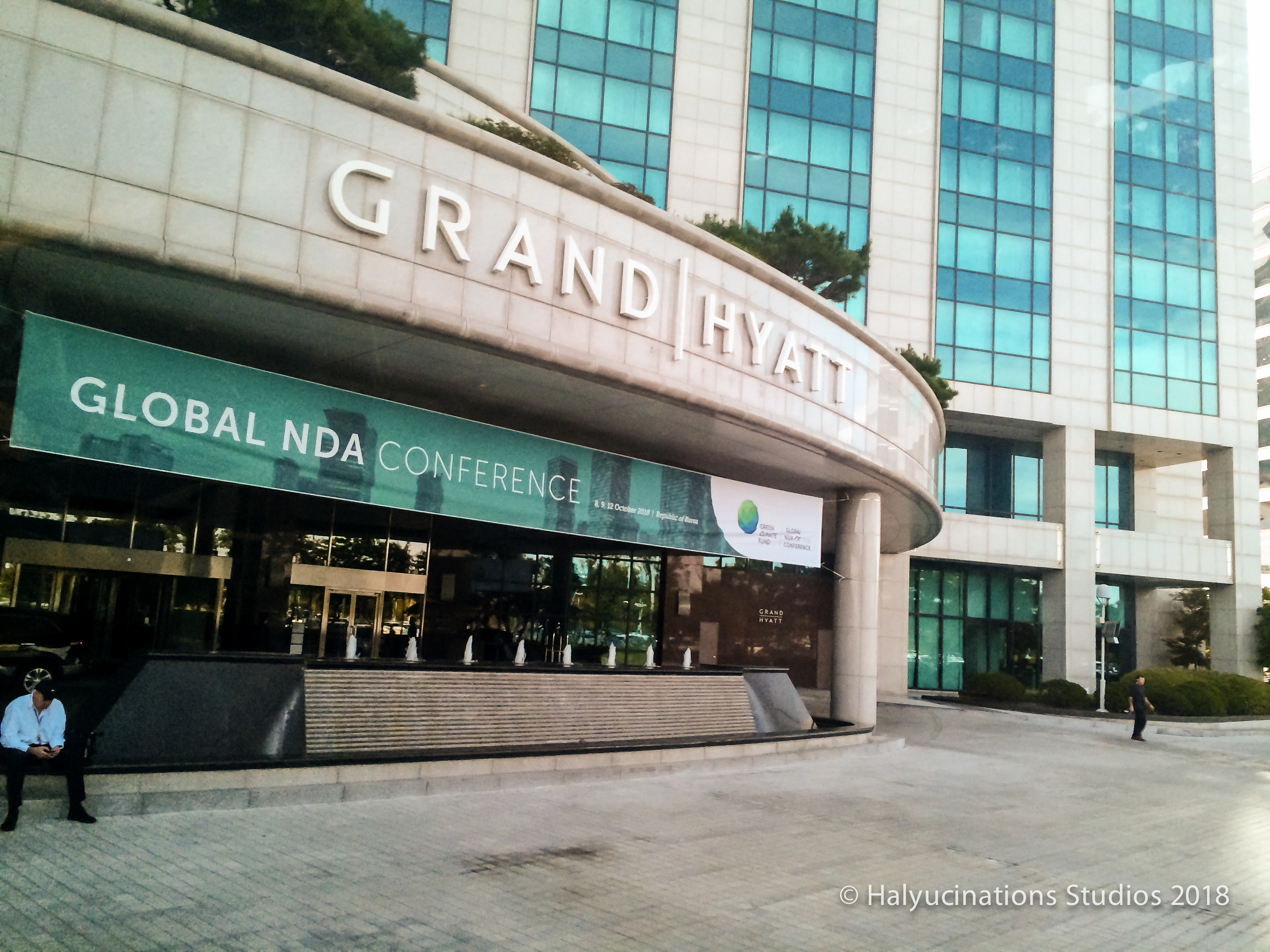
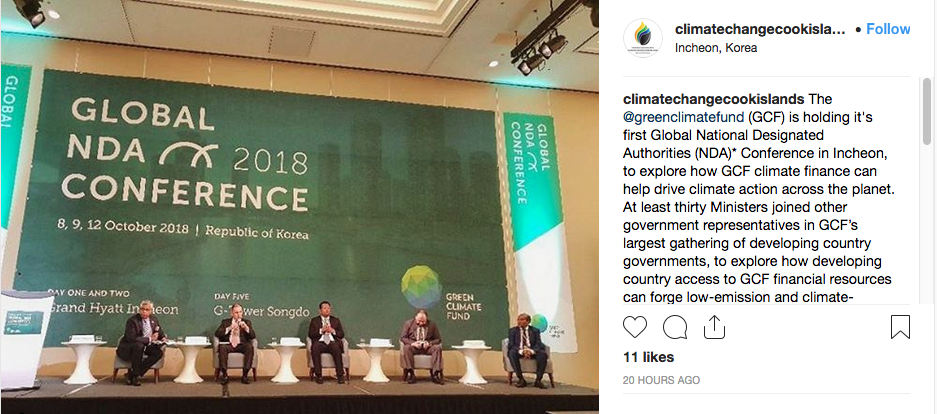
Global NDA conference @ Hyatt, Incheon, South Korea

On the 8th of October 2018, as I was leaving Korea, I noted the first Green Climate Fund’s Global NDA Conference at the Hyatt Conference Halls had commenced next door to where I had been staying.

Having addressed climate and economic policy failures by the Australian Government recently, I became interested in how these representatives of the global community were discussing climate investment opportunities to facilitate the reduction efforts against greenhouse gas emissions.

https://twitter.com/climatechangec1/status/1049466838684495872

Later the next day, I learned that during the opening sessions it was reported that Thelma Krug, the Vice Chair of Intergovernmental Panel on Climate Change (IPCC) said “The IPCC report is a bridge between the science and policymakers – limiting the temperature increase to 1.5℃ is not impossible,”

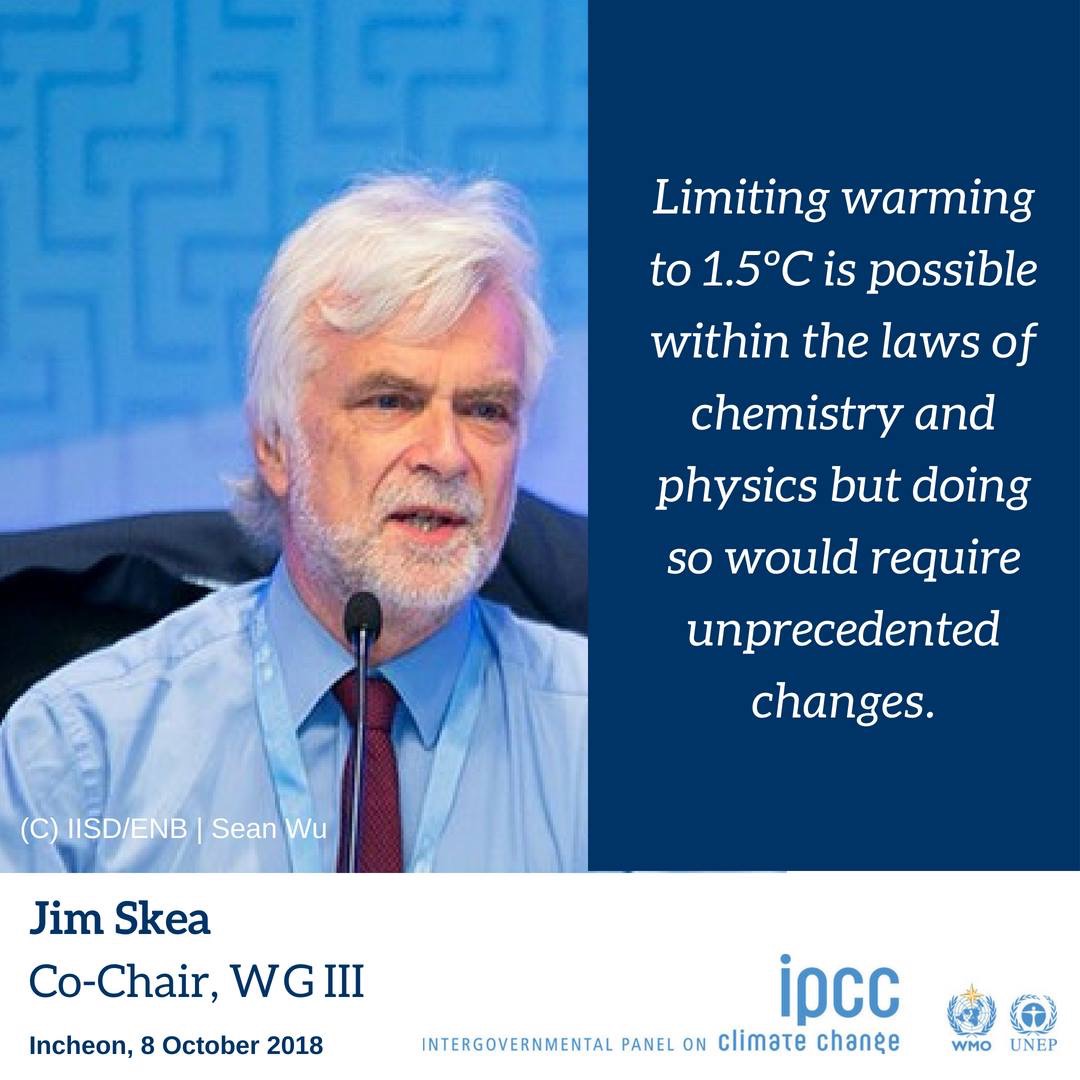
Jim Skea, Co-Chair of the IPCC Working Group

At the same conference, Jim Skea, Co-Chair of the IPCC Working Group noted, “Limiting warming to 1.5ºC is possible within the laws of chemistry and physics but doing so would require unprecedented changes.”
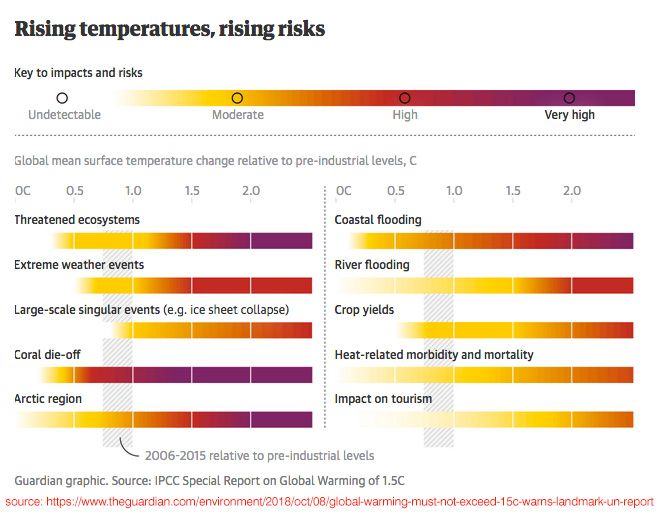
There was an evident emergence of urgency arising within this conference that repeatedly referenced the IPCC Special Report of Global Warming. It is only with immediate and focused effort can we prevent global temperatures rising above 1.5°C. (The report is available at http://ipcc.ch/report/sr15/ which includes its summary for policymakers.)

The question on everyone’s mind is, of course, are we up to that challenge and can we do it in time?  It is well observed in literature and public commentary that the greatest obstacle to adoption of climate change mitigation is not the science, but the political policymakers and their conservative media support. Notable is their reluctance to take scientific advice over significant business lobbying and financial donations. Hence the desire to either shift the climate change discussions away from the political arena or build a “bridge” the economic policymakers of the world have to cross. The later is what the IPCC report attempts to address.

Back in Australia, the IPCC report bridge to our policymakers seems to have suffered the same fate as that of the Ludendorff Bridge at Remagen in 1945 at the end of World War 2. It similarly, has been captured by allied forces (western political democracies such as Australia and America), and they are hell-bent on no one crossing it. Hopefully destroying that metaphysical bridge will be as difficult as was the physical one. Although that analogy is troublesome because when they eventually destroyed the Ludendorff Bridge, it was never rebuilt.

Regarding climate change mitigation policies, legislation, measures and institutions the CLIM index (for measuring these factors comparatively for 95 countries) places Australian 55th in the world somewhere after Mongolia and Egypt but doing marginally better than Belarus and Uzbekistan both of whom have economies that are heavily based on fossil fuels. Just as a point of comparative interest, the United States is 45th in the world.

Meanwhile back in South Korea (18th on the CLIM index), the participants at the Global NDA Conference know that the South Pacific and Asian regions have the most to lose if climate change is not mitigated.  Across the continent from the Korean NDA conference, the South China Morning Post had previously reported.
“Australia’s new prime minister will not revive plans to embed carbon emissions targets in law, a thorny issue that triggered the ousting of his predecessor in a party coup.” It is not merely a matter of “revival” of policy plans but hostility to even considering implementing any. Pressure by the Institute of Public Affairs (the policy lobbying arm of the Liberal conservatives) to exit the Paris Climate agreement is exemplified by their policy propaganda piece, “Why Australia must exit the Paris Climate Agreement”.

In the early history of that “party coup”, it was evident the conservatives held out hope that Dutton’s potential rise to power meant an end to the Paris Climate accords. While the emerging choice of Prime Minister, Scott Morrison has ruled out exiting the Paris Climate accord, he has decided to deny any further funding to the global climate fund. Claiming in an interview; “I’m not going to spend money on global climate conferences and all that nonsense.” So I can assume it is safe to imagine that the Australia government was not contributing to the NDA conference in Korea, despite Australians having contributed to the IPCC report.

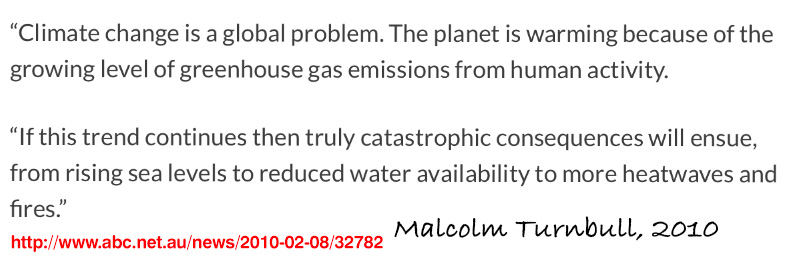
Strong opinions held by Malcolm Turnbull

Australia’s recalcitrance in following the leadership of European and British nations in preference for American policy adherence is disheartening and irresponsible. The failure of leadership on climate change by Australian Politics is well recognised even abroad in other countries.  Ironically, the delays on mitigating climate change risks instituted by one Australian Prime Minister had previously been considered a luxury we could not afford.

While the political ideology denies the science in preference for economic overtures and lobbying of financially significant fossil fuel interests, the future of the planet and our collective ability to survive climate change is at stake.

Back on October 9th the Deputy prime minister and leader of the National Party, Michael McCormack stated:
“I’m very much supportive of the coal industry. I understand the IPCC report, and I’ll certainly consider what it has to say, but the fact is coal mining does play an important part of our energy mix in Australia and will do so going forward. [The government is not about to change policy] just because somebody might suggest that some sort of report is the way we need to follow and everything that we should do.”
Since the report has emerged, the government has not backed down from this position and confirmed their rejection of the IPCC report to back away from coal power over the next 30 years.

The consequences of heating up the planet
The consequences of heating the planet

For a country replete in land and sunlight for setting up solar power generation, the excuses against transitioning our energy supply are feeble.  Options include intermittent power supplies provided by solar panels, to the 24-hour power supply of solar reflectors heating molten salts,  Wind and geothermal, although intermittent, backed by the hugely successful battery storage exemplified by the much faster supply response by the South Australian Tesla batteries set up by Elon Musk, is also potentially plentiful.  Scotland expects to harvest all its electricity via renewable means by 2020 and California expects to be complete by 2045. While this nation and state had both different starting points, what has made the difference is not technology, but a political imperative to pursue the goal to not continue to heat the planet.

We have untapped employable resources in Australia, with already  2.383 million people under and unemployed and not enough job vacancies to absorb even 8% of that number.  We have the educational resources with 42 universities and 59 TAFE institutions dispersed across metropolitan and regional areas of Australia. This is, despite a concerted effort by conservatives, to restrict access to education. Spending money on innovation, employment and educational resources to boost climate change mitigation infrastructure is a clear growth strategy for our economy, according to the Treasury. Other Nations have demonstrated evidence that climate mitigation has been economically prosperous. What we don’t have, is the political will to act to survive anthropomorphic climate change.

Fear mongering about climate change mitigation by the Liberals, the IPA and mining/coal lobbyists is not based on evidence or the examples of nation-states on this planet. Climate change disharmony (evidenced by increasing global heatwaves, and abnormal climate events) on the other hand, are increasingly apparent. Scientists and experts at these conferences have for decades repeatedly warned us, time is running out, and we need to act soon and fervently. If big business lobbying and political ideology are all that stands in the way of averting a climatic breakdown, then we as Australians need to vote out of office anyone who even remotely risks the future of our planet, in preference for greed and power.

Filed Under: Environment, Health

The wages of pollution is tax

September 14, 2018 by James J. Morrison W.G. Dupree Leave a Comment

How is it that recent parliamentary bloodletting over tax breaks and electricity pricing continues to detract from steady planetary exsanguination?  Are we now to accept that farm tours, milk levies and infrastructure spends are to be the ready tourniquets for our Australian economy?  The political focus on Tax breaks to increase wage rates while the world’s climate renders economics a mute subject, for a planet less habitable, is a distraction we probably can’t afford long-term.  The political rhetoric around these subjects is diversionary, and there is little truth expressed in the alleged relationships between these subjects.

Taxes for wages while climate destroys economies

[Read more…] about The wages of pollution is tax

Filed Under: Employment, Environment, Politicians, Taxes

Coming Out

July 4, 2018 by James J. Morrison W.G. Dupree 1 Comment

As a fervent lobbyist for the Marriage Equality movement, or in the past a Musical Theatre performer or before that a male dancer in everything from Ballet to Rock n Roll, the tag of “Gay” has followed me for much of the latter half of my life. So is now the time to be coming out? I still do a regular Tap Dance Classes even though at times my feet reflect my years with grumbles of “let me know when your admitting your age and giving this up”.

My very first words in the Guardian - on a veggie planter box
My very first words in the Guardian – on a veggie planter box

An associate on a Facebook page now called “Equality for LGBTIQ Australians” sent a message to me. The renaming of the group is one I am accredited with having suggested when it’s original identification with the marriage equality debate was over because we won that fight in parliament.  He asked if I would submit a few words about “coming out” as part of a call for submission for an anthology called “Growing up queer in Australia“.  As usual, I was both flattered and took pride (if I may use that word) in earning yet again, the suspicion that I must be “gay”.  The truth is, I am not!  Not that I haven’t had some misgivings about that in the past, but I will tell that story later herein.  I belong to that common garden variety “heterosexual married man with a female wife and a child living in suburbia” class.  Well, perhaps not “common garden variety” but “straight” nevertheless.  A “coming out” story of sorts, I can, although, provide which carried me from a North Queensland boy in the heartland of rampant proudly anti-gay heterosexuality to the fervent lobbying for marriage equality evident in the history or articles here in my blog and other media publications.

The Deep North

Leadership that does trickle down

Brought up in the deep North of Queensland and North Western outback schooling where the suggestion that you might be “gay” was an insult, I never thought I would consider the tag of gay as something I might take as a point of pride.  One boy in our school amongst the mullock heap of Charters Towers‘ former gold fields, did associate himself with that tag.  Alan was a long and skinny lad whom I often suspect made that claim more out of a desire for notoriety and a desire be noticed.  Nobody was ever sure if he was, but he certainly got noticed and not in a kind way.  Boarding schools in the deep west between Townsville and Mount Isa were not places where comradery and tolerance were features of the schoolboy culture.  Teachers still canned students for misbehaviour and these teachers were rated by students by how much blood they could draw in canning. Students, encouraged by an atmosphere of abuse, provided a reflected pattern of pain upon anyone that was classified in any manner as different.  In my case, it was a congenital physical disability with my feet, and in Alan’s case, he claimed to be gay.  Bullying was just something you lived with, and the only relief was the short few weeks you spent at home between terms.  I felt sorry for Alan, and I thought, if it is true, this was not the place to “come out”.  After extensive surgery at 17 at least my feet could pass for “normal”, and I would never need orthotic calipers again. The subsequent sporting achievements that I pushed myself through gained me some small respect and a little less of the usual schoolboy oppression. Alan’s claims diminished over time, and he left the school, and I never saw him again.  I never returned to Charters Towers and never responded to any of the “old boy reunion” treaties that followed me around for many years after that.

College

College life at University was a sudden immersion into a level of freedom, I’d never experienced before, and on reflections years later would describe my first year as “fun”, going wild with the consequential failures in some course subjects.  I settled down thereafter and completed my degree over a longer time than the university normally allocated for it. Part of the settling influences was the local Uniting Church and a fellowship of what would be, lifelong friends.  The Uniting Church was gaining a reputation as the “rainbow church” because of their social justice agenda that supported the Gay community.  Despite that, I still held a perspective that being tagged as “gay” was something to be avoided.  I honestly don’t believe I was ever comfortable with the more ardent evangelical opinion of some college evangelicals, that being gay was a “God-ordained hated sin“, but by the same token, I wasn’t defending the gay community either.  Then on a holiday visit to Brisbane, a friend offered me a stay overnight at a home of a lesbian couple. I was pre-warned and told not to “freak out” at witnessing any “affection” as people of a religious persuasion were want to do. I was a typical poor student and free lodgings for the night was never to be refused.  They were not weird or unusual and were delightful hosts, and I left wondering, why all the fuss?

Dancing my feet off

Pas De Deux dancing
Pas De Deux dancing

After College, I moved to Brisbane and resumed dancing which had more to do with the disability I had been born with, than any emerging gay leanings.  Part of my early childhood therapy my mother put me through, was being taught an “adjusted” form of ballet by Anne Roberts. As an adult, I eventually did private training and competed in dance competitions and emersed myself in the world of dance continually challenging myself to see how far a person with my remaining foot disabilities could take it before someone realised I was a fraud.  In Sydney, I took up Ballet, Jazz, Ballroom, Tap dance, Rock n Roll and eventually competed in state and countrywide competitions earning merits and in some cases, later winning open level competitions in Pas de Deux and Rock n Roll.  I would dance with as many as three dance partners at any time in different dance styles each week.  I would later go into the auspices of musical theatre and perform on stage to dance and sing for appreciative audiences.  Following that, I would teach & run a “disabled” dance project for seven years. You can probably begin to see why the tag of “gay” began to follow me. In the meantime, I revelled in being able to move on my feet in a manner which doctors long ago had cautioned my mother, was an impossible dream.

Tagging

In the midst of all that, the “gay” tag arose with frequency.  One partner with whom I danced for six years, finally asked me after our first three months as partners, whether I was gay. I was both amused she hadn’t figured out I wasn’t but complimented that she thought I must be. She was a Pas de Deux partner with whom intimate physical handling was part and parcel of our choreography.  Together we later won the South Pacific Dance championships in Pas de Deux held in Sydney in 1994 to which my entire family were witness.  Our choreographer told me she saw my tearful mother crying in the stands. A Jazz ballet choreographer I had was mentored by for nearly two years asked my “jazz” partner whom I’d been dancing with all that time, the same question about my gay status.  Kylie burst out laughing while denying the assumption. It had been asked behind my back, and when I later asked what she had been laughing at, she told me. I thought that was cool.

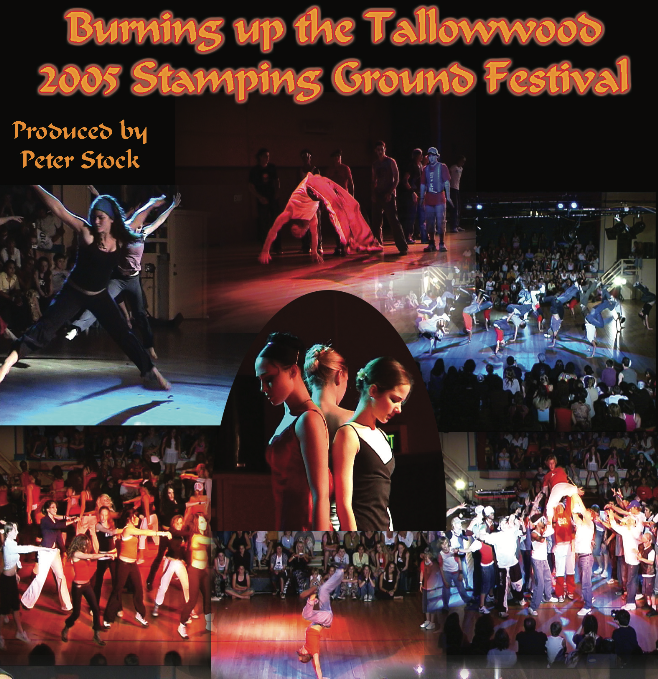
For me, the point at which I shifted from my North Queensland biases with finality was the very first “Stamping Ground” men’s dance festival. It ran as a dominantly men’s dance festival for two weeks in Bellingen, NSW, for ten consecutive years.  I attended every one, but the first one was the game changer or the point at which I “came out” from my fear and bigotry.  Being the only male in some dance schools where there would be as many as 20 adult female dancers was a lesson in holding one’s tongue when a degree of “sexism” occurred from time to time.  Because I was a guy, in what some women, felt was an intrusion on their domain.  Others like the Dance Captain held me with a different perspective. One evening during rehearsals and the frequent calls for the “girls” to perform better and stop “marking” the routine, I coughed loudly in an attempt to bring to her attention, I was not a girl.  Donna turned to me and said, “You’re just one of the girls, get over it”.  Not unlike the status that was given to me by the militant lesbian conclave, with which my girlfriend regularly hung out.  Over dinner in an Italian cafe, they decided to tag me with the moniker “honourary lesbian” as an induction concession into their community.

Stamping Ground

Stamping Ground dancers

So when Peter Stock in Bellingen decided to run a men’s dance festival, I enrolled the moment I heard about it.  The initial 100 men in attendance were predominately from Melbourne Dance companies (probably because that is where Peter had a dance history) and the teaching was a smorgasbord of styles and opportunities.  I revelled in not being a minority, and the guys were predominately fabulous, intelligent, energetic, talented, encouraging, and … gay as all hell.  I found myself conflicted.  The turning point for me was late one night lying in the dark in a lower bunk in the local backpackers.  I couldn’t sleep as I wrestled with how attracted to these men I felt. Did that mean I was gay? Then something happened I have never forgotten.  I was in the mixed bunk room, presumably because the owners probably thought a male dancer had to be gay and therefore a safe occupant to share a room with members of the opposite sex. A young and beautiful Scandinavian girl climbed back down the upper bunk ladder opposite my bunk, clad in only white underpants and bra. Suddenly distracted from my brooding, I watched her descend and head off to the bathroom.  I suddenly laughed at myself and whispered, “Nope, I’m just fine as I am“.  I just thought these guys I danced with were great and I enjoyed their company as dancers and men. Frankly, they were men of better character than a lot of the heterosexual men I encountered in the dance halls, who often confessed they were not there because they revelled in the joy of dance, but simply to “meet” women.  I rolled over and went to sleep, finally at peace. I never saw the young scantily clad Scandinavian girl again. But whoever you were, “thank you!”

The Flatmate

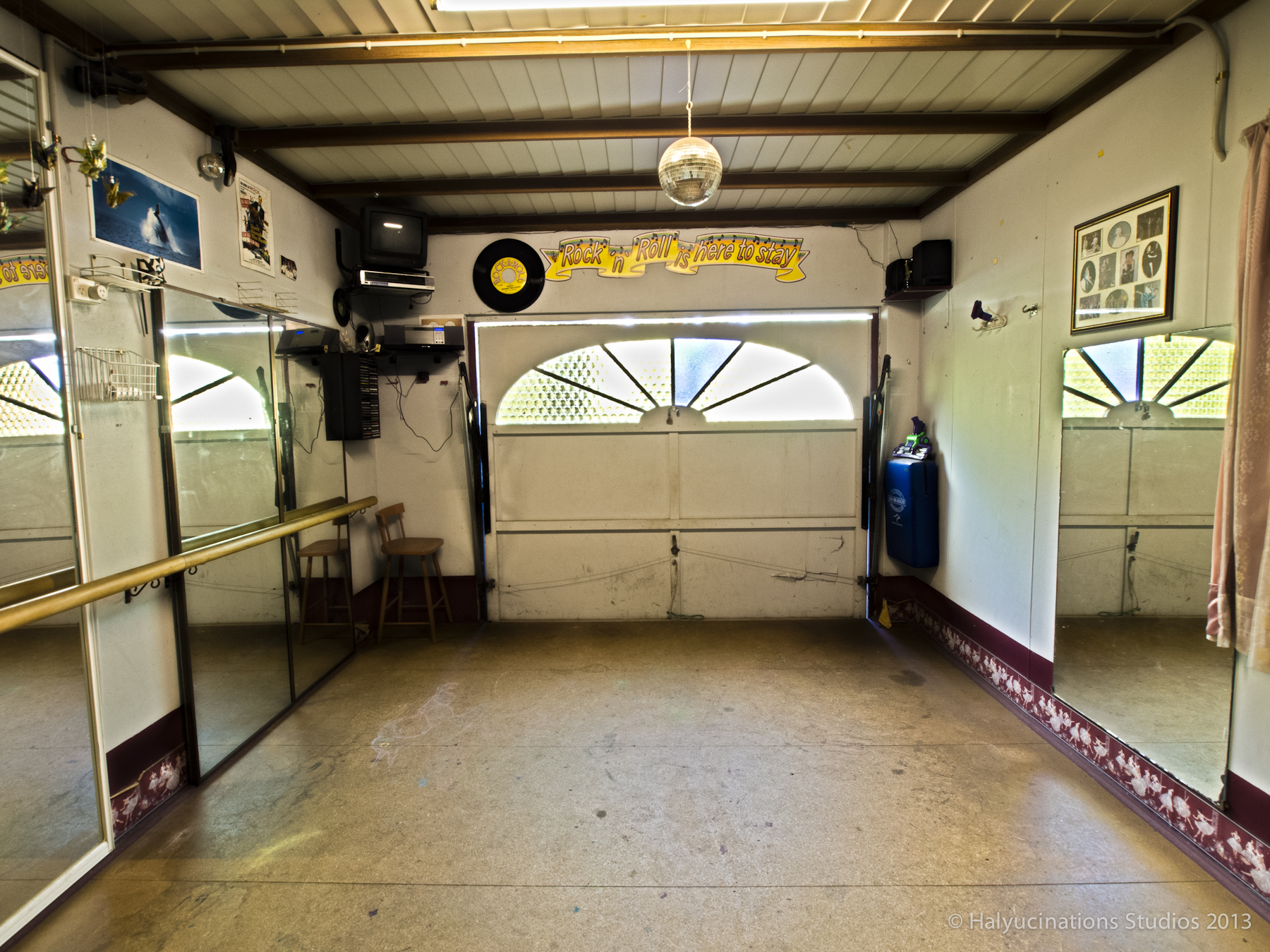
An ex-garage come Dance Studio

Years later a woman applied to a flatmate matching agency looking for a vetted person with which to share a house.  She phoned me upon being matched via the agency’s profile matching program.  But we had trouble arranging an appointment because of my musical theatre rehearsal schedule.  On the day she did arrive, she met me outside on the footpath just as I was saying farewell to an occasional ballet partner from Bellingen who had stayed the weekend.  I shepherded her through the garage which had been converted into a dance studio complete with mirrors, sprung floor, ballet bars, wallpaper displaying ballerinas dancing and a mirror ball twirling from the centre of the studio.  My Cat rushed past her legs, and I introduced the multicoloured short-haired tortoiseshell cat to her as “Sarafina“, named after an African dancer.  Her first thought was “GAY!”. Absolutely and verifiably!  Perfectly safe to move in with this prospective flatmate.

Our Bridesmen
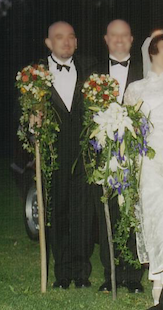
Our Bridesmen

Two years later we were married in the Uniting Church in Bellingen and on that day, two men (a gay couple of several years) stood beside us in our wedding party, to support our vows to one another.  We deliberately changed the phrase “man and a woman” to “two people” in our vows, officiated by the Uniting Church minister from my college years. The two men were her best friends, and they have been lifelong friends to both of us before and since.  It was for them that my wife wanted to have our vows changed from the “standard”.  Over the years even though these friends have moved to Melbourne, we have encouraged each other’s respective relationships, tackling the concerns that the struggles of relationships we mutually often encounter. We stay in one another’s houses when we are in each other’s respective cities and have honoured the bonds that have held each other together.  It was for them that I have written and argued and lobbied for marriage equality over the years because I dreamed of the day when we could both stand beside them as they took their vows, and make promises to uphold their marriage, as they had done for us.

Finally the end game.

Montsalvat wedding party

It was a cool Saturday afternoon in June 2018 when in the halls of Montsalvat in Melbourne, when the celebrant asked myself and my wife, “Who gives these two men to be married?”  My wife and I replied simultaneously, “I do!“.  Dressed in a white suit, not unlike the one his dad was wearing, I watched with pride as my small son stepped forward as “ring bearer” to hand the rings to our two friends.  After two decades of being together, they could finally marry.  It was my privilege to be a part of their wedding, and a long-held ambition which if you look through my blog you will find was clearly articulated as the reason I defended Marriage Equality and repudiated the postal survey across all manner of feeble excuses by the political, religious, libertarian and just plain unthinking list of obstructors.  As darkness descended on Montsalvat and the joyous sounds of over a hundred guests revelling in the final victory of equality and love, one thought repeated in my mind.  “Mission accomplished!”

There will still be battles to fight against the ongoing bigotry of ignorance and small-mindedness but I am now OUT and proud of who I am and whom I seek to defend.

Save

Save

Save

Save

Save

Save

Save

Save

Save

Filed Under: Sexuality

Do unto refugees

June 23, 2018 by James J. Morrison W.G. Dupree Leave a Comment

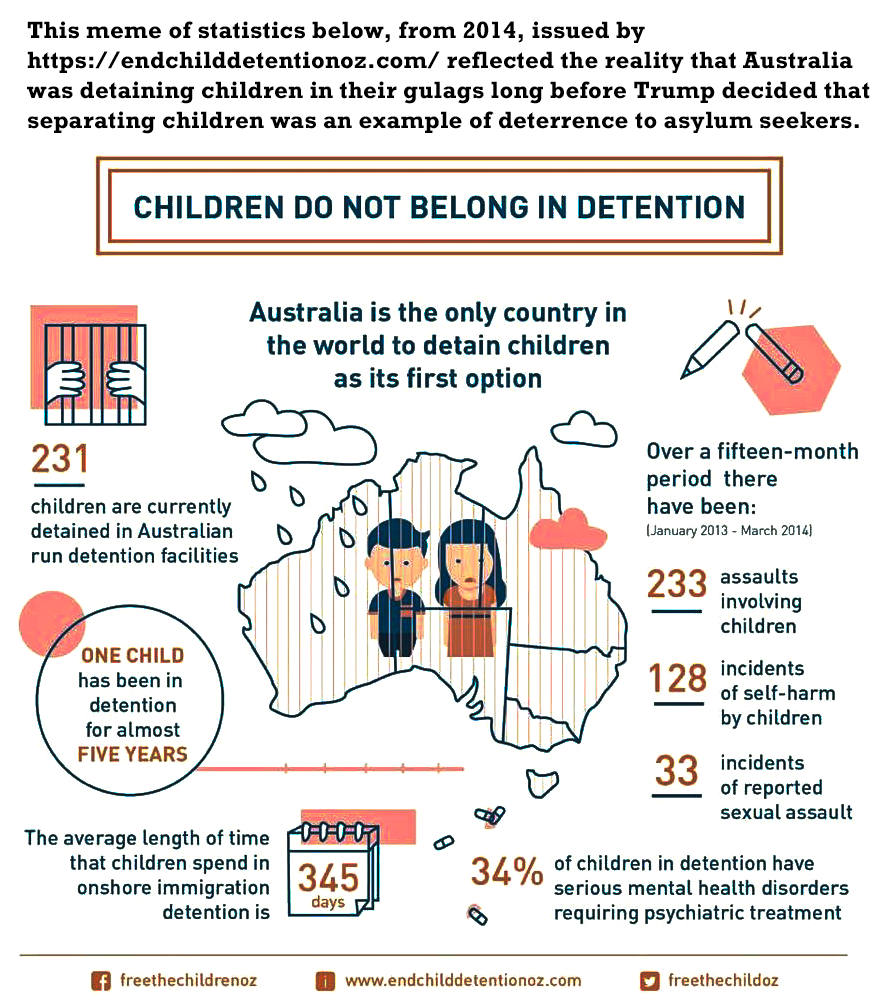
Australia, a world leader in child abuse.

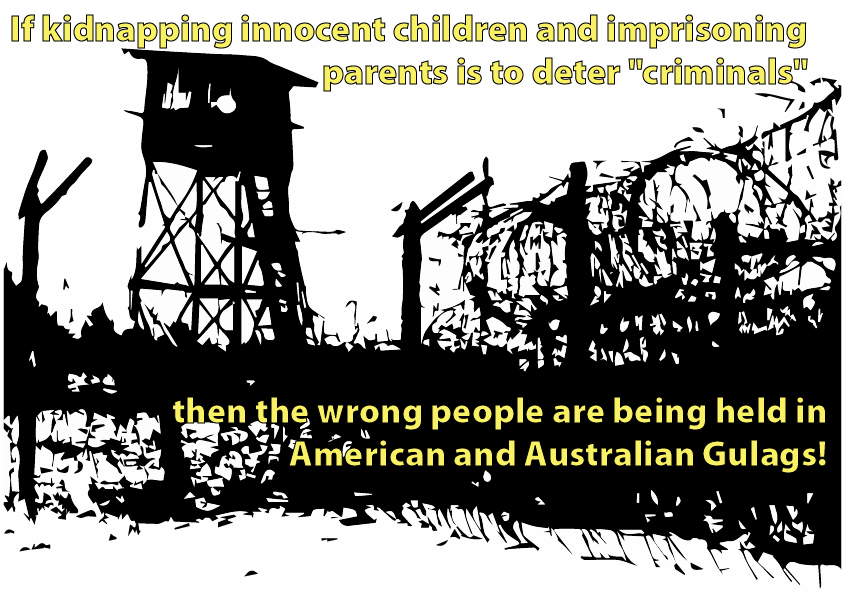
Deterring and imprisoning asylum seekers is gaining popularity in the western world.  Punishment by separation of children from parents now has occurred in both Australia and America invoking community backlash. Many are unaware such practices have a long history in both countries.  America forthwith will follow Australia’s indefinite detention practices, even as Trump repudiates his policy on separation of children from parents. These practices contravene the Refugee Convention to which both America and Australia were signatories. Dutton’s commentary emphasised the desire to be rid of this troublesome convention.  He commented, “I think there is a need for like-minded countries to look at whether a convention designed decades ago is relevant today”.

I want to examine the relevance of international principles that underpin our history of refugee conventions versus “deterrence” against refugees and their smugglers.  As I write this, it is Refugee week, so it is an ideal time to investigate the principles behind “deterrence”.

Human Rights convention

On the 10th of December 2018, Democratic Nations worldwide will celebrate the 69th anniversary of the adoption of the Universal Declaration of Human rights.  Australia’s longest serving Prime Minister, Robert Menzies (a man no one will mistake for a soft-hearted humanitarian) signed the UN Refugee Convention on January the 22nd, 1954.  Prime ministers that followed him, both Tony Abbott and John Howard spoke of him being the father of modern Australian Liberal ideology. The former Liberal Prime Minister, Malcolm Fraser would have argued that in the 21st century, the Liberal “apple” has rolled a long way from that “tree”.

As we recall Human Rights Day, we will have long distinguished ourselves as the least compliant signatory to the Human Rights convention amongst any western democracy.  When even North Korea can legitimately accuse us of human rights abuses, you know we have moved to the “dark side of the Force.”

Internationally speaking, things have taken a turn for the worse since World War II.  We have now reached a point where both America and Australia are actively abusing people, including children, who have fled from torture and prospective death in their own country.  Some have even died within our offshore gulags and deaths have already featured in Trump’s “zero-tolerance” regime. I want first to outline some historical legal cases which illustrate how international courts have responded to the idea of subordinating human rights to achieve political ends.

The German Autumn

Following the days from 1970 to 1977 clashes between the Red Army Faction (RAF) with Germany culminated in the “German Autumn,” and the kidnapping and murder of industrialist Hanns Martin Schleyer.  Brett Walker delivered a speech to the annual Dinner of the Civil Liberties Society on Friday the 24th of November 2017 in Sydney in which he described the events of the German Autumn. The Germans had resisted the kidnapper’s demands. Schleyer’s son after failing to pay the ransom privately in part due to both inadvertent publicity and the German government’s reluctance then sued the Government in an attempt to save his father.  The principle invoked was the invariable nature of human dignity by which he called on the government to make an effort to save his father’s life.  The specific implication was that nobody should use another, as an instrument or means, to achieve an end.  This included hostage-taking with demands. The court rejected the son’s claim in less than a day, and within days, his father was killed.  Standing up to hostage takers has consequences.

Aviation hostages

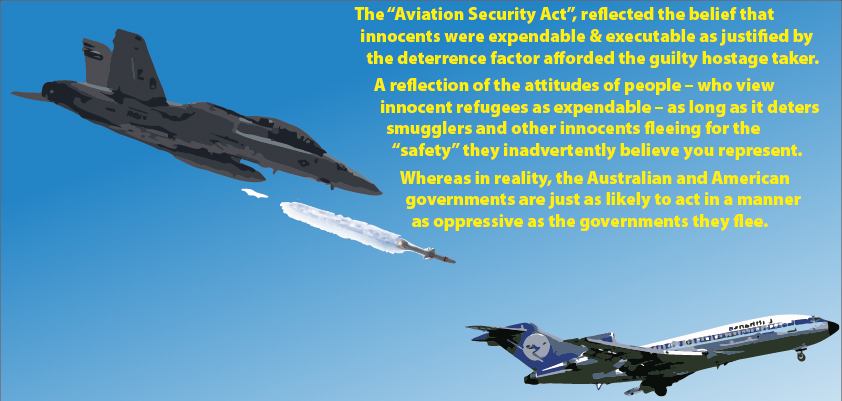
In 2006, the constitutional court in Karlsruhe received a complaint from flight crew staff about the decision that the government had justification in shooting down aircraft held hostage in the air under the ironically named “Aviation Security Act”. The Bundesverfassungsgericht declared that legislation which would have allowed the German Air Force to shoot down hijacked passenger planes was unconstitutional and as a counterproposal reinforced the constitutional right to life and human dignity.

Securing on air matters

In reviewing the decision, the court would not accept the argument by the government that the passengers were very probably soon to die anyhow. They instead held to another principle, that the State could not reduce passengers and crew to the status of “objects” they can kill at the pleasure of the State, no matter the amount of time the people, may or may not, have left to live. The court essentially held that human life should not be used as a bargaining chip or as instruments to achieve an end of preventing the possibility of further deaths. Presuming that one would then be as guilty of the Machiavellian principle that the “ends justify the means“, which is, of itself, the ploy of hostage taking.

Machiavelli versus the Golden Rule

The categorical imperative in a civilised society is that we should act in a manner towards others that we think can, and should be, applied universally.  Brett Walker espoused the principle that one should “do as you would have, you and everybody else, done by.”  To extend this principle, it would mean that one would never abuse fellow inhabitants of this planet as instruments for some political end or project.  The welfare and dignity of people is an end, but never a means by which you should cause one person or group to suffer to produce some advantage for others.

Instead, an alternate approach has been pursued with vigour and enthusiasm by recent immigration ministers such as Scott Morrison and Peter Dutton. Successive Australian governments (supported by the electors who have repeatedly voted for them) have created policies, legislation, and facilities, which are deliberately designed to mistreat and hold refugees and asylum seekers in conditions that we would not subject criminals in our internal national incarceration system.  All designed and executed for the declared purpose of “deterrence.”

If punishing the innocent is the law then the "law" is criminal.
If punishing the innocent is the law then the “law” is criminal.

Under criminal law, the idea of “deterrence” is to sentence a legally convicted person, in a such a way as to deter others from committing such crime.   It serves idealistically to deter the convicted person from re-offending.  What is not part of the principle, is the notion of taking people who are not guilty of a crime and have not been convicted of having acted criminally, and visit upon them adversity and punishments to deter and modify other people’s conduct.  That is abuse to use innocents as a means and abrogate their human dignity as an end.

Other democracies handle refugees far more efficiently and with less abuse than we do. But this perversion of law, criminality, morality and deterrence did not merely begin here with the likes of Howard, Ruddock, Morrison and Dutton! In fact, they have refined the “art” of this deliberate moral bankruptcy to heights which previously only totalitarian dictatorships or regimes have practised. Our pathway to abuse instead began with far humbler utterances from the lips of Labor politicians.

Queue jumping

While Keating is often attributed with the “queue jumping” rhetoric,  the source of this phrase came from Immigration minister, Michael MacKellar, in 1977 in a Radio Australia broadcast.  While Malcolm Fraser was attempting to placate the fears that hordes of Vietnamese “boat people” were descending on Australia, the Labor Party was busily trying to capitalise on fears about this “unchecked invasion”. Herein lies the original authorship of the fear mongering, which was eventually to become the backbone of refugee policy in Australia. Back then, the Australian public’s reaction, though cautious, was a far cry from the response of this century.

Bob Hawke and Paul Keating continued Labor’s negative attitudes towards refugees when they decided to use mandatory detention for asylum seekers at Port Headland, WA. This deterrent detention was the next step in both perspective and action.  That act being detention of Cambodian refugees who arrived at Pedder Bay in November of 1989. They were held till 1992 while the government tried in vain to exclude these asylum seekers from seeking justice and the rule of law in the courts.

Like most immigrants, once allowed in and embraced, they became highly productive members of the Australian community.  Up until that time, the maximum period of detention allowed for refugees had been 273 days.  That limit in the Migration act was removed in 1994, paving the way for the era of indefinite mandatory detention. Similarly Trump’s executive order on June 20th – presumed to be reuniting families – seeks indefinite detention of families as a challenge a 1997 law that limited immigration detention to 20 days. (See Flores v. Reno).

Racism as policy

The success of Pauline Hanson’s racism in 1996 and the rhetoric of Phillip Ruddock in treating refugees not just as “queue jumpers”, but as cunning manipulators of peoples sympathy with an evil intention; marked a change in Australian attitudes.  [Pg 31] The implication is that refugees sought to reap the rewards of an Australian Economy, steal our jobs out from underneath Australians, and then use their consequential “enormous wages” to finance terrorist plots against our nation.  Not only does Australia’s falling wage rates make this unlikely, but the patient absurdity of the argument that traumatised people fleeing for their lives – often with their children – were even capable of such manipulation, was surprisingly and naively accepted by the public.

The strange attribution of motives

The proposition that terrorists hide out in detention centres was absurd back then and still is.  Myths like these grew in number over time.  Until the emergence of Pauline Hanson, it had not dawned on the political party system that racism inherent in public policy was a vote winner.  John Howard realised that he could leverage refugees to acquire political power, which he did as a boat named the Tampa approached Australia. In particular, his use of the meaningless phrase “illegal immigrants” helped reframed the public debate to John Howard’s advantage in August of 2001.

The Pacific solution.

The Pacific solution followed in September 2001 as Howard opened offshore gulags on Christmas Island, Manus Island, and Nauru. After Howard lost government to Kevin Rudd, that new government closed them down.  When Rudd lost leadership to Julia Gillard, she reopened them, and once Tony Abbott became PM, he massively escalated the usage of offshore detention.

On his ascension, Malcolm Turnbull did little to change anything by way of policy; he did allow Morrison and Dutton to leverage legislative control of these gulags.  The relish with which Dutton justifies the Government’s actions on Manus beggars belief.  Given that even the vaguest sense of decency would suggest, “deterrence” ought only to be addressed, at least under the pretence of regret.

Drowning in moral ambiguity.

It's not that complex to support children
It’s not that complex to support children

If we did in any honesty, believe that preventing “drownings at sea” was a moral imperative, then indeed we would be doing what is being done privately by individuals with large boats in the Mediterranean Sea. We would be sending boats to rescue these people, rather than stopping their boats, turning them around and returning them to danger, which is what the Navy now does to prevent “drownings at sea”.

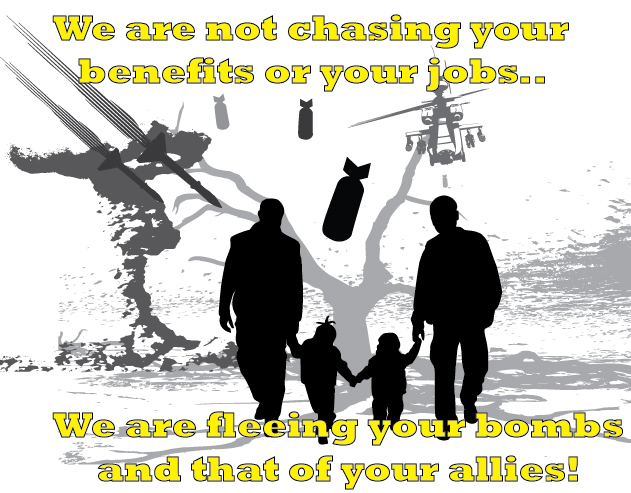
We should also most certainly be addressing the issue of why such people have a well-founded fear of persecution. One so strong, it leads them to seek protection on foreign soil in the first place. We would be spending money at the UN addressing the veto factor or refusing to engage in the sort of bombing and attacks on overseas middle-eastern targets that create push factors that generate asylum seekers.

The notion of leveraging human beings to achieve an end to stop the boats and prevent deaths at sea is comparable to the tactics of hostage-takers in the 1970s. Our government is holding an innocent population hostage to achieve a goal at which they are, evidently, unsuccessful. Claims of having stopped the boats have turned out to be exaggerations or spin. Boats filled with refugees seeking asylum are still “setting sail” to come to Australia as recently as last month. The illusion, however, created and maintained by the government’s response, is to either intercept the boats; pay off the “captains” to turn the boat around; or simply to declare that successful arrivals – when they do arise – don’t count as “arrivals“.

The End – does not justify the means.

Community garden signposts

The end is not justified by whatever means are applied to achieve it. Instead, it’s the acts of compassion that define a civilised society, when they are brought to bear as the means to address an issue and achieve a goal with justice. And that, Mr Peter Dutton, Mr Malcolm Turnbull, Mr Jeff Sessions and Mr Donald Trump, is something which benefits all members of a community, old and new, and which has never become outdated.

Save

Save

Save

Save

Save

Save

Save

Save

Save

Save

Filed Under: Foreign, Refugees

Bolt-fall

January 27, 2018 by James J. Morrison W.G. Dupree Leave a Comment

Satire, Sarcasm or Irony warningIn the midst of massive marches in the capital cities protesting about the choice of date for Australia Day, Andrew Bolt started trending alarmingly on social media.  Just when you thought, Andrew Bolt trending on Australia Day – given his previous opinions on aboriginals – could not possibly be good news, I had a changing paradigm moment. All of a sudden I am thinking of converting to Hinduism. If I sound confused, it is because I am no longer sceptical of karma. ?

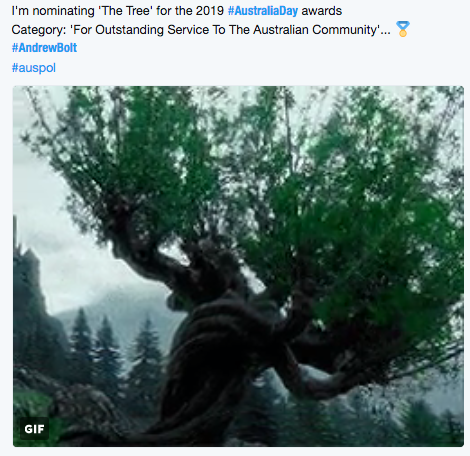
The witch hunt for which tree was responsible?

Andrew Bolt was injured after falling from a ladder while attempting pruning a tree. Despite hopeful reporting removing the decimal point, it was confirmed to be only a 3.5m fall, injuring his wrist and ribs. Medical staff confirmed there was no head injury despite the fact that behavioural indicators may have suggested otherwise. Despite expectations, no confirmation that he blames political correctness & the unions have been found although the possibility that the ladder leaned to the left as he leaned rightwards may have been a contributing factor.  Concerns have been expressed that this was probably the time to embrace his inner “tree hugger”, although some have queried if indeed the tree itself may bear some responsibility. Identifying the tree has been of some concern because the community is torn between pruning it further or awarding it for services to the community.  Sufficient to say there appears to have been no further adverse consequences to the tree, for which many on social media have expressed grave concern.

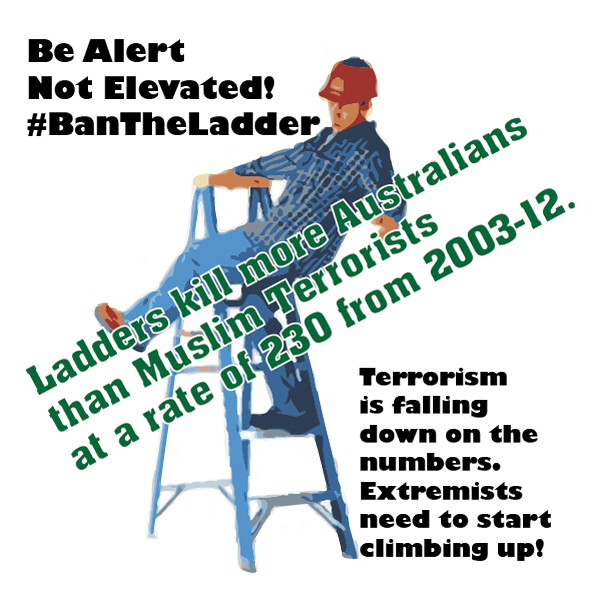
#BanTheLadder
#BanTheLadder
War on Terror such a minor threat

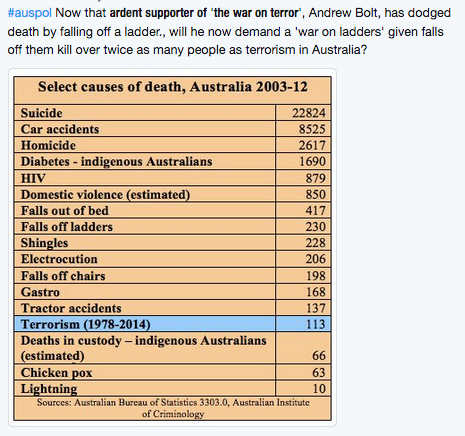
Progressives have hoped that finally, Andrew Bolt might admit having to target the wrong threat to Australians. Instead of Australia spending billions on the negligible threat of “terrorism” that kills next to nobody in Australia perhaps Bolt will suggest we re-target our spending. Perhaps it should be “Ladders” we recognise are the scourge of western society that we ought to be spending money on investigating and deporting offshore! ? Of course, he may be open now to championing the disparagement of chairs and beds as the causes of more significant numbers of deaths than even the worldwide number of Australian deaths due to terrorism. ?  (That being 113 worldwide in the last 36 years whereas beds have killed 417 and chairs, 198 in the last decade alone)

Although, one can understand why the ladder may be what represents a predominant concern.  I can see Bolt’s headlines now:
“Lone Wolf ladders terrorising Aussie households believed to be weaponising gravity“. ?

Remember it is up to you more progressive folk go out to your own ladder and assure it that you understand that most ladders are useful.  Note that while there are some aberrant ladders want to bring about the downfall of humanity, it is true that most moderate ladders are of the class that seeks to be uplifting? ?

Donations will be accepted to aid the recovery of the patch of grass he fell on between a concrete path and bench. Please note the concrete path and bench are not responsible for their unfortunate placement. ?  The ladder appears to have suffered no ill effects from the fall. ?


Filed Under: Satire

Let’s keep Australia working

January 12, 2018 by James J. Morrison W.G. Dupree Leave a Comment

The Liberals who cut penalty rates, public services, and taxes for the corporates, have come up with a slogan to replace “Jobs and Growth”. The slogan is, “Let’s Keep Australia Working.”

The implication being a vote for Labor is a vote against your job. The question we need to ask is: “Has the liberal agenda succeeded in keeping Australia working or are jobs and wages diminishing?”

Full-time / Part-time

In October 2017, Michaelia Cash promoted job growth as she claimed “371,500 jobs created over the last year, 315,900 were full time“.   Referencing the ABS’s next month’s stats, Malcolm Turnbull later said: “New data shows another 61,600 jobs were created in November, lifting the number of new jobs this year to 383,300.”  That may sound convincing and consistent. Of course, as other authors such as Alan Austin note, it is all a matter of strategically timing your announcement, so the figures fit your case.  For example, choosing a month where historically low employment featured the previous year to be compared with a better statistic this year. A slightly different choice of month or period produces different results. Statistical variations depend on the accuracy of the collection methods; underlying definitions of employment, and what dates are being compared. The ABS statistical methods for employment issues have come under considerable criticism even from within its ranks.  The ABS, although, does not engage in any statistical tampering or deception on behalf of the government.  ABS methodology follows the ILO international protocols for measuring unemployment, although the methodology does have its faults.

highly changeable variations in part and full-time employment

Monthly deviations in Full-time employment and part-time employment are significant, and cherry picking dates can be misleading.   Depending on what is your starting and ending point you can show either rising or falling employment.  What is notable is the increasing volatility of employment markets over the years.

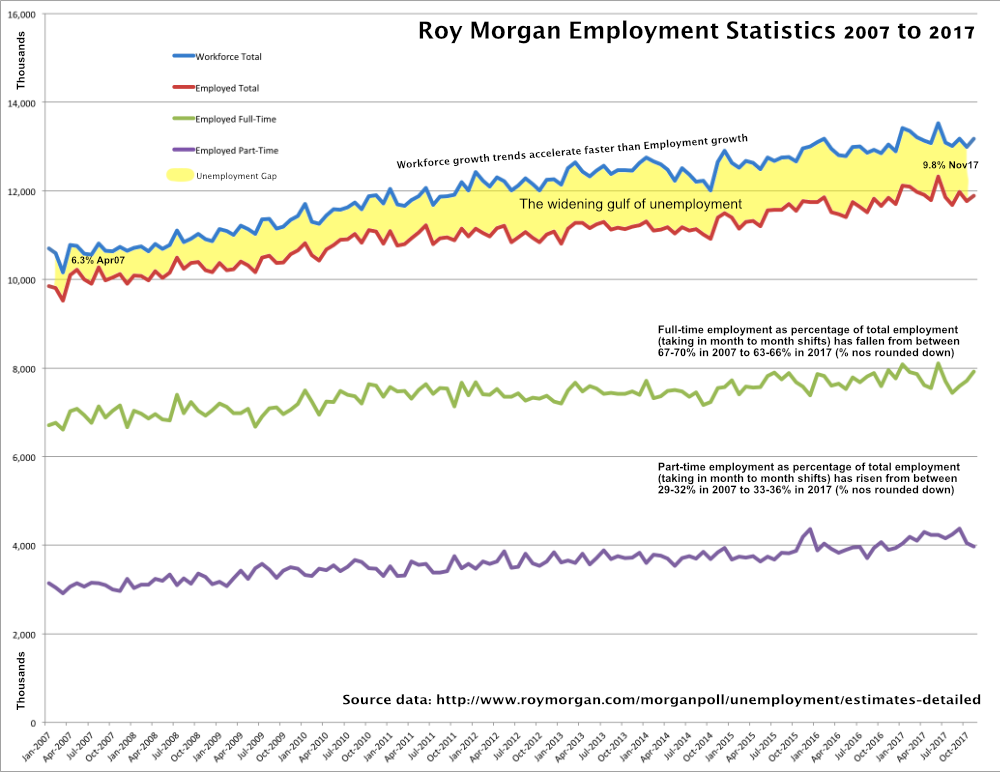
So are there alternative measures which use alternative criteria for measuring employment? Roy Morgan’s measurements are considerably more modest than the ABS stats that Michaelia Cash and Malcolm Turnbull referenced.  Their numbers for November 2017 report show long-term job expansion is in part-time jobs, with declining full-time jobs. The figures provided, show that full-time employment decreased 31,000 in the last year till November whereas part-time employment rose by 70,000.

Charting Roy Morgan's analysis of employment and unemployment from 2007 to 2017.
Charting Roy Morgan’s analysis of employment and unemployment from 2007 to 2017.

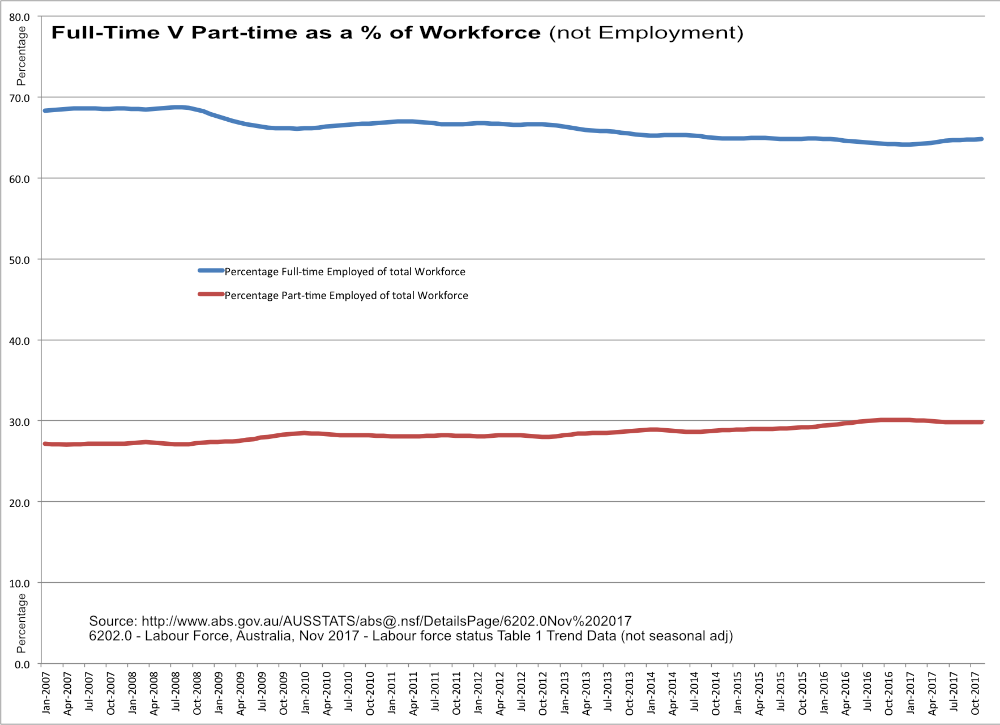
Roy Morgan’s measurements for employment and unemployment differ considerably to the ABS’s methodology for a few fundamental reasons. Morgan’s take on part-time and full-time employment also depicts it as volatile. Morgan shows that part-time employment is growing faster than full-time as the job market is becoming increasingly casualised. A point with which even the RBA agrees. Graphing these statistics over the last ten year shows a clear trend which the ABS methodology obscures while Roy Morgan’s method makes it easier to track.  This methodology is also notable for tracking under-employment, or what the ABS calls “hidden unemployment”.

Falling Full-Time V Rising Part-time as a % of the Workforce

Employment numbers have risen, but so has the total labour workforce seeking or occupying employment. The problem is that unemployment and underemployment according to Roy Morgan’s stats were 2.394 million people in Nov 2017 (18.2%). Combined underemployment and unemployment haven’t been consistently below 2 million since 2011. One has to dig through ABS’s statistics for their underutilisation figures to see a similar pattern.  Roy Morgan reports 9.8% unemployment, and for ABS it is 5.4% in November 2017. Using percentage figures in a growing labour force can be inherently deceptive. According to the ABS, our unemployment rate in Nov 2017 is at 5.4%, and the last time it was that rate was in February 2013. But in February 2013, that represented 660,000 people. By November 2017 5.4% is 708,000 people. Taking Roy Morgan’s unemployment figures for Nov 2017, we have 9.8% or 1,288,000 people.  The last time we were at 9.8% in a similar period to ABS’s 2013 figure, was August 2012, where 9.8% represented 1,205,000 people. In essence, 5.4% or 9.8% in 2017 isn’t equivalent to 5.4% or 9.8% in late 2012/early 2013. Whichever statistical methodology you reference, our labour market is worse off regarding raw unemployment numbers, casualisation, and volatility than we were under Labor’s administration.

Working Hours

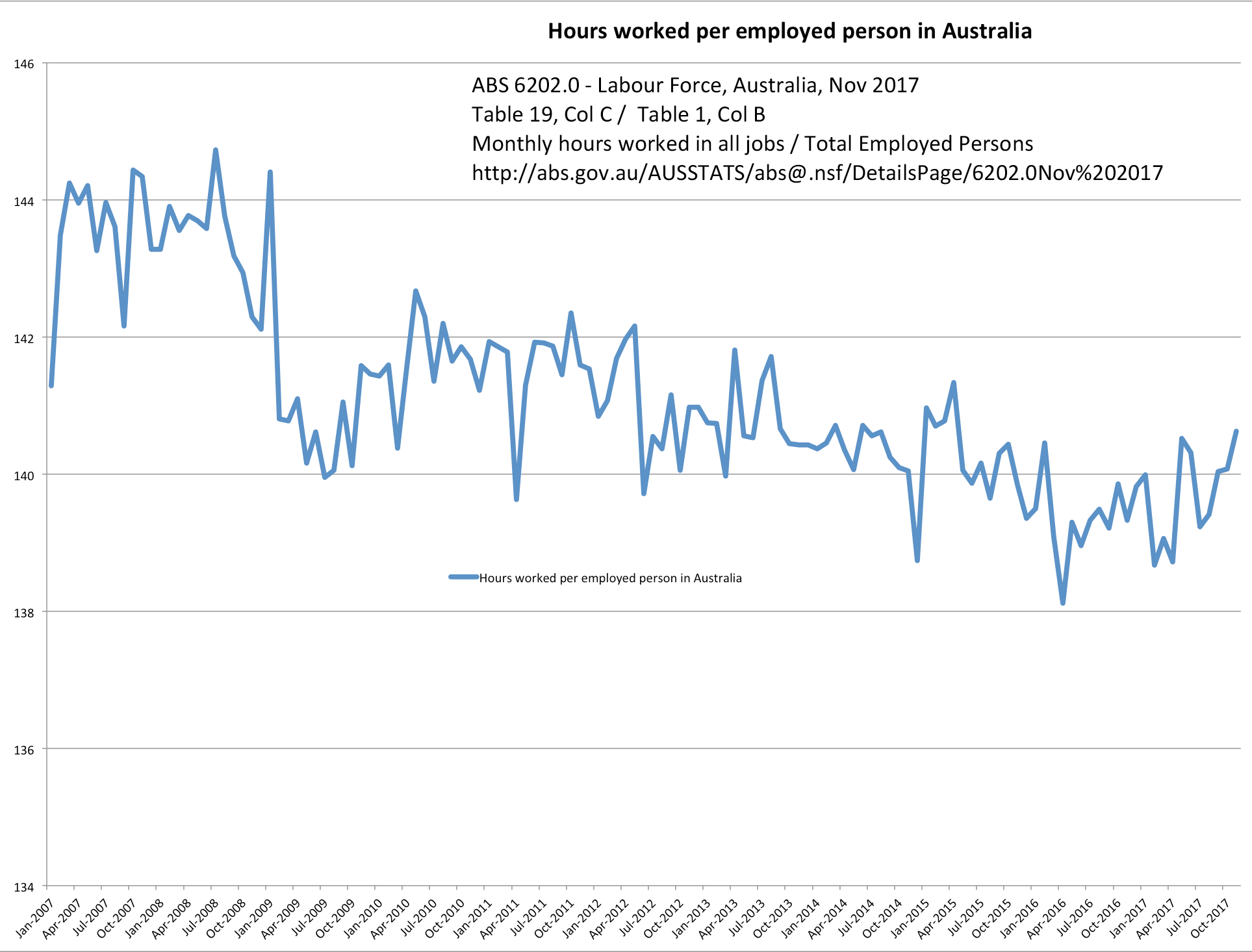
Hours of work available for the employed market

But what about the hours worked by those who are employed?  It would seem self-evident that if part-time work was rising faster than full-time, that hours worked would be reducing.  It has long been the thesis of writers such as Alan Austin.  I took a slightly different track with ABS data and charted hours worked as a function of just those employed, rather than demonstrating as Alan does, that working hours available for the Adult population is decreasing.  In spite of how you look at it, it is evident that adequate working hours are less accessible both to employed and unemployed.

Job Vacancies

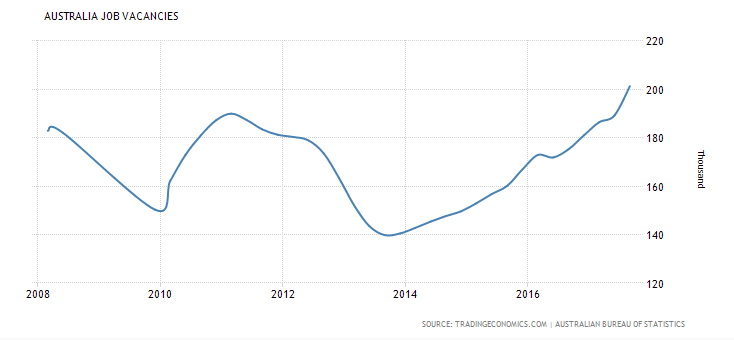
10 years of job vacancy numbers for Australia

Job vacancies in comparison to unemployed job seekers have also been problematic.  While there has been a soft rise in vacancies available over time – since the coalition came into power – it has been far below any measure of unemployed numbers (no matter the method).  The job vacancy rate for the entire continent of Australia from the government’s IVI index for November 2017 was 177,900.  In the four years of the coalition government, it has never risen above 180K  and has been as low as 150K. Now to be fair, not all vacancies (although most) advertise online.  The ANZ, although, regularly tracks job advertisements saying “Job ads growth was 3.7 percent year-on-year in December, a steep fall from 6 percent in November. In trend terms, the numbers looked a bit better at 4.7 percent year-on-year, but this was down sharply from 9.4 percent annual growth in early 2016.”  So let’s factor in these adjustments. Fortunately, Trading Economics has already done this, reporting “Job Vacancies in Australia increased to 201.30 Thousand in the third quarter of 2017 from 189.20 Thousand in the second quarter of 2017“.  Despite the increase, 201K job vacancies hardly make a dent in 1,288,000 unemployed people let alone 2.394 million under-employed and unemployed persons seeking jobs in Australia.

Wages

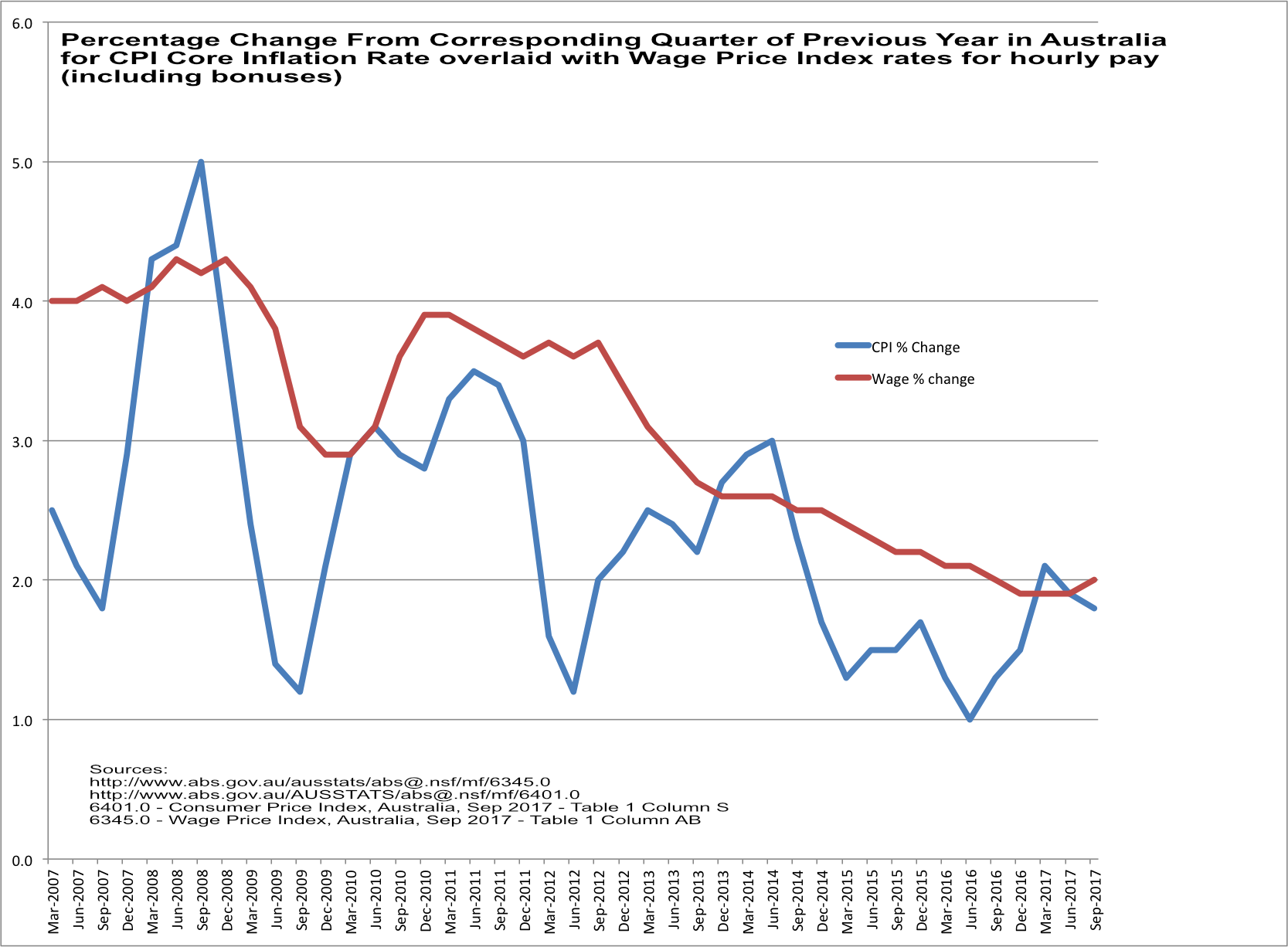
Wage rates treading water over CPI rate increases

Well, at least the employed get paid, you may – in the resignation of these dismal statistics – sigh.  Therein the news gets worse.  Wage rate growth continues to stagnate,  to levels unseen in this century down as far as 1.9% in the previous quarter.  While there is still growth, the question needs to be: Is the growth rate keeping up with that of the CPI?  The answer on the surface is “barely”. ABS statistics graphed here show that it is predominately keeping its head above water.  The CPI is widely criticised for “excluding home purchase costs“. In a country where private debt towers over GDP by 122% and housing affordability limits access to homes, this is a significant omission. “The ABS does produce cost of living indices which consider the cost of living according to your source of income – wage, pension, or government benefits“, states the Guardian’s Greg Jericho. Once you add the real cost of living factors, you will quickly realise wages are not keeping up with the actual costs of living.

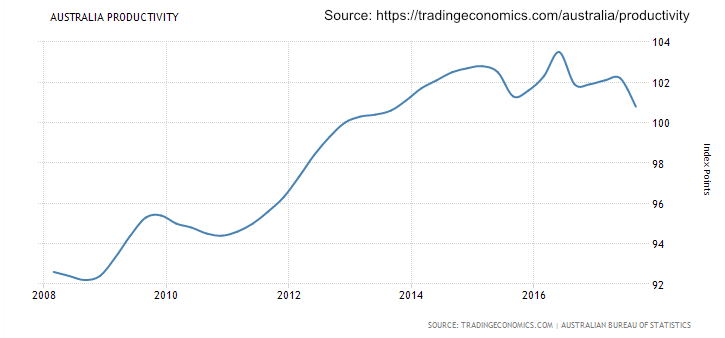
Australia's rising productivity
Australia’s rising productivity

Despite the falling wage growth rates, productivity has been expanding by all indicators. One would assume if the nation is being more productive that wages should rise accordingly. So the claim by the Prime Minister has turned from claiming the lack of wage movement is a function of a lack of security and productivity to being “blamed [for] a lack of economic demand“, despite later boasting about Australia’s economic growth. It would appear the government’s excuses change from month to month and assume nobody is keeping track.  So despite fewer hours available collectively for the employed, and reducing wage rises, the level of productivity in the country has been rising.

Job Losses

Job losses for specific industries under the instigation of the coalition will have long-term consequences for our economy.  Some of these include:

  1. Abbott and Hockey’s dismantling of the car manufacturing industry in this country for a preference for imports from China, Korea and Japan saw the end of jobs for thousands of workers with estimates from 90K to 200K losses. Hockey had admitted in Parliament that “Ending the age of entitlement for the industry was a hard decision, but it needed to be made because as a result of that decision we were able to get free-trade agreements with Korea, Japan and China.’’
  2. The government continues to seek means to support a diminishing mining industry and supply $1billion to Adani Mine.  Mining employment is contracting, but it is being promoted at the cost of a tourism industry that employs more than twice the number of people.  The tourism sector has the more significant potential for job creation than the mining sector.
  3. The coalition has overseen one in ten public servants losing their jobs, while spending on consultants has risen by $300 million. Amongst those civil servants, the tax department has divested itself of 4400 employees and their expertise in keeping tax avoidance in check, so private companies could stash money overseas whether acquired via profits or tax cuts rather than use it to employ more people in Australia.

Foreign Workers

Numbers granted the predominant classes of working visas for Australia.

There are 37 Visa sub-classes available for a foreigner to work under in Australia of which the 457 sub-class received significant notoriety.  As at the end of 2016, there were 95,758 people in Australia who had that visa. That sub-class is being replaced by two separate classes – as announced in April of 2017 – for the future, so tracking worker visas will ultimately be more complex from here on in.  Consequently, as a result, the 457 class numbers will naturally begin to shrink which will no doubt be a talking point for the government from hereon.

The lessor referenced 417 and 462 Class of working holidaymakers has had 63,988 visitors granted with working rights last year up until September of 2017. Mapping these three visa classes over the last decade gives one a perspective of for whom the government focusses on “keeping working”.

Now to be fair even if all these people left tomorrow it would still not have a significant impact on unemployment and not simply because the numbers are “low” relative to the numbers of unemployed. As usual, it is nuanced, and for a greater understanding, I have written on this at greater length here.

Conclusion.

It is, although, evident that the claims by politicians about their success in managing an economy that has produced employment is highly subjective and lacks credibility. Whatever the coalition is doing, it is NOT keeping Australia working.

Filed Under: Employment

Sodomy and Pell

November 23, 2017 by James J. Morrison W.G. Dupree Leave a Comment

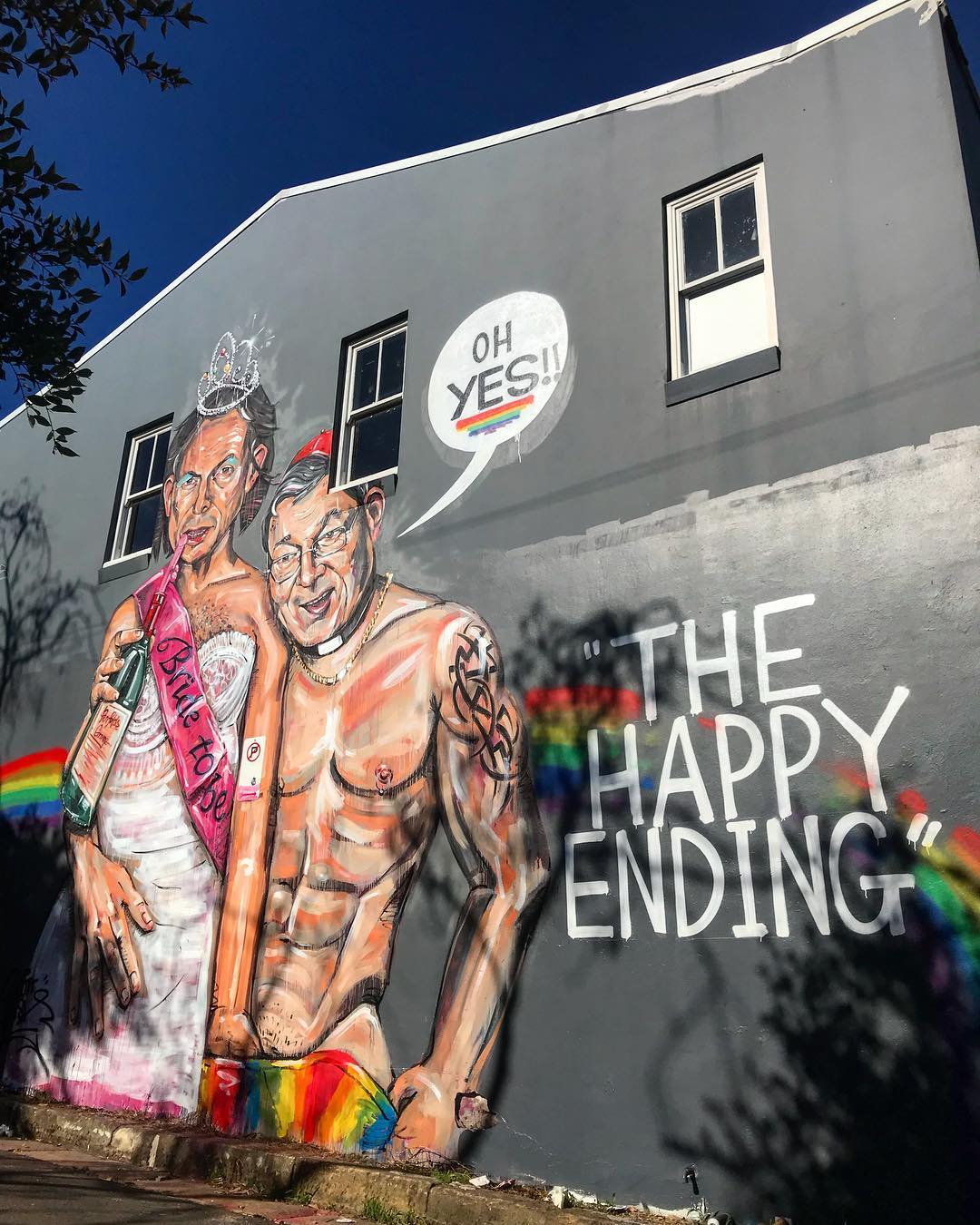
Has the cover-up of sexual abuse by the religious leaders in this country ceased, or is a culture of concealment still entrenched and showing up in new forms, as art (or what occurs to art) reflects life?

Scott Marsh’s original mural celebrating Marriage Equality and lampooning Abbott and Pell mere hours before defacement by right-wing religious groups commenced.

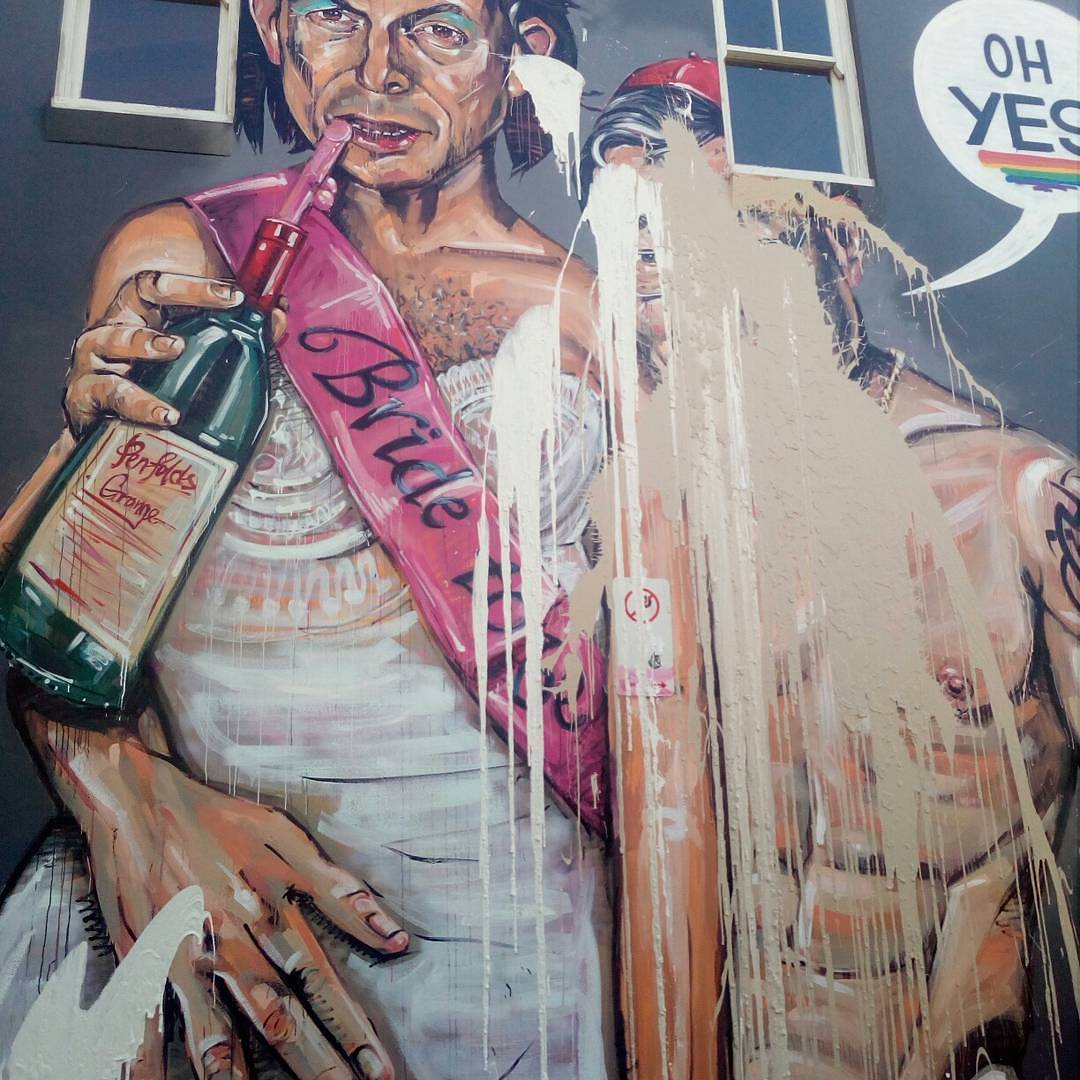
There is a pub in Newtown I walked past last week, in which the artist, Scott Marsh, was on a small scaffolding rig painting a multi-storeyed image of Abbott and Pell. It was being painted in a rear alleyway at the back of a local pub.  I could not recognise the characters as the painting had only recently started and thought to return later to see how it turned out. Unfortunately, within 6 hours of it being completed – according to the staff at the Botany View Hotel – Pell’s image had been defaced with a paint splatter leaving only Abbott recognisable.

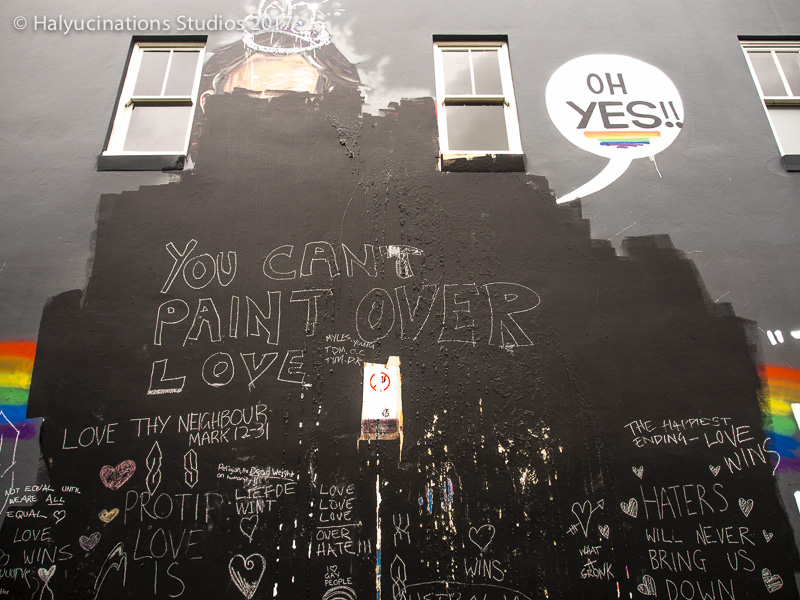
The initial and ironic “whitewashing” of the lampooning alleyway mural of Pell’s image by Conservative Christian protestors.

Sometime after that, it was entirely painted over in black allegedly by members of a right-wing Christian religious group, offended at the portrayal of Tony Abbott in a Wedding dress beside a half-naked muscular Cardinal Pell. An interview with a local resident revealed that earlier on, people had gathered to protest over the wall’s image on Friday night.  While initially claiming to be Catholics complete with incense burners waving ceremoniously at the wall, my catholic informant noted some discrepancies in their “Catholic” behaviour. Upon befriending them – to seek further information – he learned they came from three separate Christian churches and were not the “Catholics” they initially pretended to be.

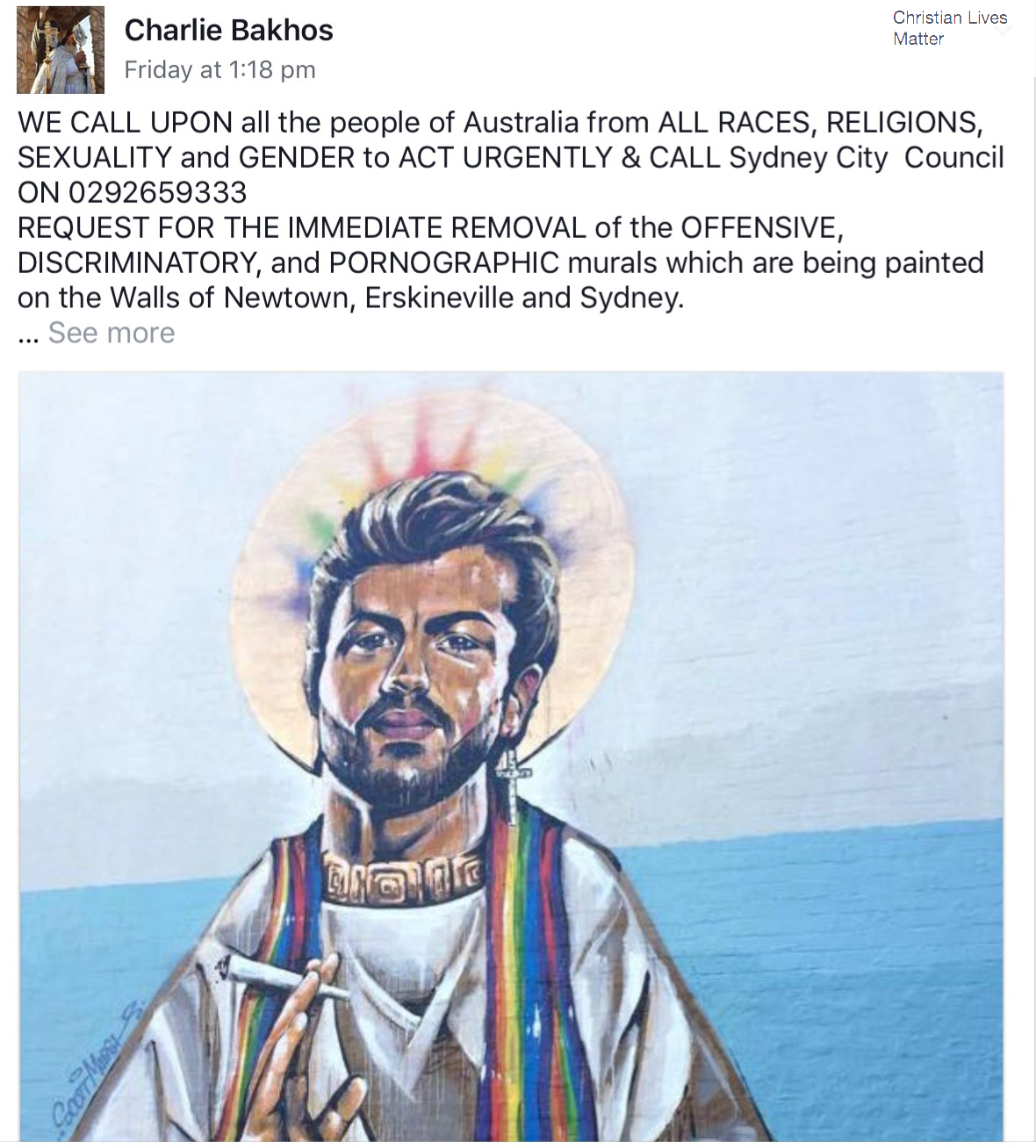
Christian Lives Matter Facebook post calling for the removal any further images painted by Scott Marsh and referencing his year-old as yet undefaced image of George Micheal shown on private property.

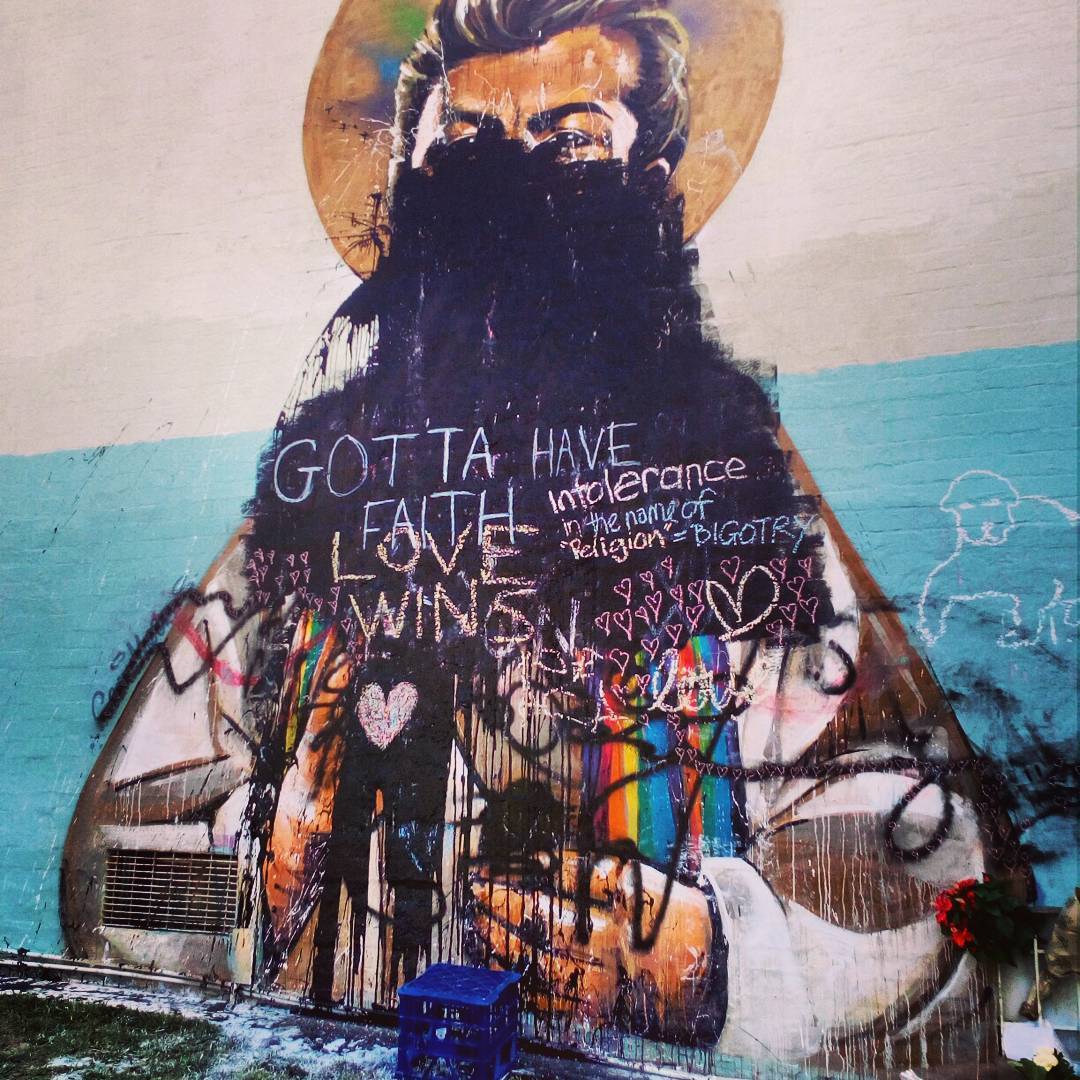
The vandalism of Scott Marsh’s work didn’t stop at the image of Abbott and Pell. A Facebook group called “Christian Lives Matter” instigated and provoked “Christians” to continue attacking Scott Marsh’s work which included a privately commissioned image of George Michael on Devine Street Reserve, painted by private commission a year ago. One person has been arrested for defacing that image, and another lost his job, when he was filmed defacing the mural while wearing his employer’s logo on his shirt. They are both facing fines for vandalising private property.

Christian Lives Matter Facebook post praising the defacement of George Micheal’s image on private property in Newtown

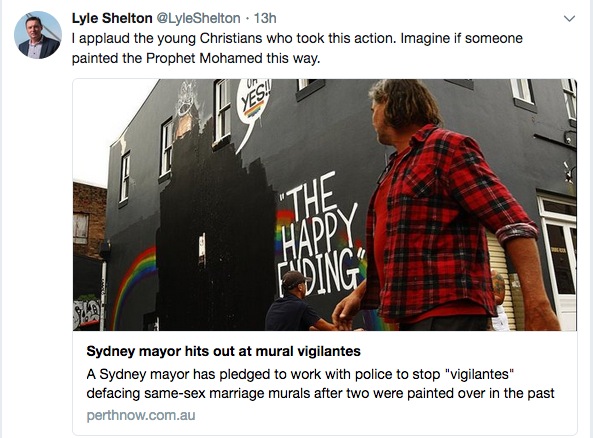
Social media from the “No” and “Yes” vote campaigns reacted.  Abusive phone calls were received by the hotel staff and licensee.  Lyle Shelton defended the vandalism equating either Pell and/or Abbott to religious leaders such as Mohamed. One might understand if it was an offensive image of Christ, but Cardinal Pell?  All these factors have made me aware, that the fight for Equality for the Newtown’s community of diverse gender, sexuality and race, is far from over. (The Newtown electorate of Grayndler had a 79.9%  “Yes” vote)  An associate on Facebook titled his long opposing proclamation against the images with “Sodomite Nation!“.

Lyle Shelton from Australian Christian Lobby comparing Cardinal Pell to be the spiritual equivalent of the prophet, Mohamed.

“Sodomite Nation” is an interesting turn of phrase. It is more interesting to note – like the word “gay” – how the meanings of words change over time. Religious concerns about homosexuality are often based on the fallacious belief that sodomy, as it was expressed in the Bible, was about homosexuality – a word that didn’t emerge in English till the 19th century.  The biblical text, although, had no such connotation.  Even Robyn Whitaker from Trinity College pointed out that Sodomy, as it was revealed in the biblical literature, is about rape and sexual abuse. Sodom and Gomorrah is a story about people rocking up at your door wanting to break it in, to have their way with you or your guests. It’s not about love or sex; it’s about abuse, it’s about rape. If what happened to Lot and his family occurred today outside your house, you would phone the police, scream for your neighbours to help and load your shotgun in defence. It is not about sexual preferences it is about RAPE and SEXUAL ABUSE. It’s sure as hell not about LOVE – gay or otherwise!

That the church has illegitimately changed the meaning of the word is understandable if you’re in the Catholic priesthood, as you wouldn’t want the bible to be condemning your particular predilections towards activities you’re infamous for, concerning small children. Two men who defended Sodomy (in its original biblical meaning) were adorned in effigy on the back-wall of a Hotel at the end of Newtown. One representative guarded the other via enormous political power, while the other defended and hid perpetrators of a crime only to be rewarded by the Vatican, while the biblical God allegedly destroyed a city over that evil. Pell was himself accused of sexual abuse and although an unproven accusation, his defence and lack of concern for sexual predators in the church have been well established.  The church whose original role as defenders of the poor and disenfranchised has been co-opted to enrich and protect the wealthy and powerful and further disempower the class it once served. Abbott content to safeguard this rising new religious force in the world, and set about bringing about changes in the political system to achieve more significant protections for this conservative “Christian” force. Abbott redirected funding from the Royal commission into sexual abuse which attacked his religious friends, to the probe into Labor’s insulation scheme which effectively attacked his political enemies.

These examples of this corruption of:
1. language to misdirect people about the real sin of sodomy,
2. Identification and prosecution of sexual predators,
3. Justice by seeking to de-funding abuse investigations,
4. the mission of the church to protect the poor, marginalised and our children,
are becoming more efficient.

When considering what harm has been done to children generally by religious and political leadership, we need to consider the broader scope of injury. These include:

  1. Attempting to protecting Pell and the church from an investigation into sexual abuse. Abbott and his support for Archbishop Pell’s character and redirection of funding belies Australia’s apparent repulsion for child abuse.
  2. Immigration detention and abuse of children which both Morrison and Dutton oversaw. This refugee child abuse was even confirmed by their own instigated investigation by Philip Moss confirming the abuse, as did the one by the Human Rights Commissioner.
  3. Increasing entrenched poverty for children by “attacking” single parents such as did Kevin Andrews by defunding of single parents via a thinly disguised excuse to rebuke their choice of children, over attempting to acquire rare full-time work.  The examples of further political child abuse are numerous from cutting aid overseas, or locally by reducing the Child Care Subsidy, or removing access to the affordability support element under the Community Child Care Fund, or slashing $930.6 million so that family day care educators cannot receive Commonwealth child care fee assistance.  These are just some of a list I have referenced before.

These actions are all being instituted by people who publicly claim a religious affiliation. To be fair, both the religious and political classes are acting entirely consistent with one another to attack what Christ most vehemently opposed. “Whoever causes one of these little ones who believe in me to sin, it would be better for him if a great millstone were hung around his neck and he were thrown into the sea.”(Mark 9:42).

Graffiti over the blackened and defaced mural of George Micheals by locals incensed at its disfigurement but promoting love and an end to bigotry.

Christ said nothing about homosexuality. Although he did indicate that being a “born eunuch” (an ancient reference to homosexual men – Matthew 19:11-12) was a gift from God.  On the other hand, Christ had a lot to say about abuse of children and the marginalisation of the “least” of people, as well as about Loving one another, which seems to be points that many in this conservative evangelical community appear to have missed. That anyone in the church could mount any defence for either Pell or Abbott speaks, in my mind, volumes about the person they choose to be.

Chalk graffiti protests by locals who were proclaiming love overcoming religious hate over the blacked out artwork by Scott Marsh in the alleyway behind the Botany View Hotel.

So a local artist chooses to celebrate “love” as opposed to “abuse” by having painted two of the figureheads of “child abuse” on a wall in the back alleyway of a Pub in a manner that would be “offensive” to them.   Scott Marsh recognised that both these men are offensive to the Newtown community. Art is supposed to challenge society, and it certainly seems to have been challenging to some. “Christians” from churches defended Pell and Abbott by painting over the image that apparently offended, despite that the wider community finds these two men, offensive! Who, pray tell me, stands on the higher moral ground? Is “art” and even the “obscuring of art” reflecting society or in this case segments of the church. It seems to me that the conservative church would still prefer, the sins of these men, were covered up.

Save

Save

Save

Save

Save

Save

Save

Save

Filed Under: Sexuality

Drug Law reform

October 15, 2017 by James J. Morrison W.G. Dupree Leave a Comment

The War on Drugs, like the ones on terror, waste, poverty, and crime, are metaphors for institutional failures to address fundamental problems in our society. Aside from the fact that it is never clear when any of these “wars” will be over, it is also the rhetoric of a political failure to address social reform.

To date, the West’s pursuit of these wars has piled misery on misery (as wars are prone to do). Such wars ostracise the victims, casualties and collaborators in conceptual battles that have no actual target but certainly cause collateral damage.

The “War on Drugs” neither defines the problem nor allocates appropriate consequences for drug use. Moreover, this language does not improve the plight of those suffering. There is although, a long historical process which led to the development of the three international drug treaties and the international drug control systems for the more academically inclined.  But for now, let’s simplify.

What is a drug but an ingestible substance designed to have a physiological effect? From that perspective, the orange juice I had for breakfast, morning tea and lunch fulfils that description, as does the small white pill I then popped to alleviate the acidic reaction in my stomach, that repeated orange juice consumption had created. Depending on what that pill was, government legislation may deem it acceptable or not.

The “War on Drugs” is usually framed to attack those substances any given society, country or State consider either “illegal” or harmful.  The media often frames drug addiction in terms of the (over) consumption, possession or distribution of goods that legislators have deemed to be “illegal”. However, that classification can, of itself, be arbitrary. For example, none of this captures the harm done by legal drugs, such as the prescribed opioid epidemic currently killing thousands of Americans (and making its way into Australia), or similarly, the ravages of alcohol and nicotine. Indeed, one of the key imperatives and justifications behind the push for law reform on drugs is that the classification of a “harmful drug” may not necessarily be based on any adverse physiological or psychological effect.  Cannabis is a case in point.

Cannabis in 19th and early 20th centuries was widely used in the USA and even for a while carried by pharmacies as a drug to treat migraines, rheumatism, and insomnia. Hemp was used as a superior textile used for ship sails and caulking. Just as Hemp grew to become a possible threat to US textile industries, Cannabis faced a challenge when in 1925 in Geneva a meeting of the League of Nations banned globally three plant-based drugs – opium, coca and cannabis.  America although did not follow suit till the 1930s when it became the patsy drug that the Department of Prohibition took on as a replacement cause for alcohol prohibition.  The ending of alcohol prohibition left Harry Anslinger (the G-man in charge) with a government department twiddling its thumbs and needing a drug to prohibit.

Racism and fear were used to outlaw Cannabis despite medical advice that it was not dangerous. An “alternative fact” campaign was waged demonising the drug and the Mexican sources for it until legislation banning it emerged. America then pressured trading partners to follow suit. You can read the real story behind its illegitimate banning in the links provided, but for now, let’s focus on drug law reform and how far behind, Australia sits, in its efforts.

Staying with cannabis, as a medically demonstrable drug to treat disease, we have moved way beyond migraines, rheumatism, and insomnia. Strains of marijuana have been used to treat Arthritis, Asthma, Bipolar Disorder, Attention Deficit Disorder (ADD), Cancer, Crohn’s Symptoms, Dyspepsia Symptoms, …. and a long alphabetical list of conditions listed on the Medical Marijuana site. There is although, an enduring medical debate as to whether it does effectively treats these conditions or not. The reluctance of the Therapeutic Goods Administration (TGA), AMA and college of Physicians to approve medical marijuana is not based on the medical opinions expressed for treatment remedies in places like Canada. Canada provides access to medical cannabis to nearly 130,000 people, while the TGA in Australia has acknowledged only 140 people here.

Like our medical authorities, there was a time when Canadian Doctors expressed their reluctance, as they did in a report in 2014. Three years later, the surge in demand for it as a medication, has seen doctors evidently more comfortable with its efficient use.

However, despite Australia being a nation of immigrants, we have an inherent distrust of learning from anyone else’s success with new or progressive technologies, whether the subject is medical marijuana, renewable energy, transport, immigration, education and the cost of education. We are just inherently stubborn, like a rebellious teenager, unwilling to learn from older advisors/countries.

Other examples of our recalcitrance in Drug Law reform, is Heroin-assisted treatment. As of last August 2017, it will be 20 years since John Howard prevented the proposed scientific trial evaluating the effectiveness of prescription heroin, killing off six years of scientific research.

In the meantime, countries such as United Kingdom, Switzerland, the Netherlands, Germany, Canada, Belgium, and Spain have all demonstrated success with the impressive results of their heroin-assisted treatment programmes. Denmark has also agreed to a similar plan although in its case started the programme without running a trial.  Why still be running trials when you can review the results from everyone else?

Staff assessment of patients determines not only that their patients have a medical dependency on the drugs but also that other approaches to wean them off this dependency have been unsuccessful. As such, it is not a first-line treatment, but more often a facility of last resort, and apparently a highly successful one.

Indeed, it is now not only made clear that heroin-assisted treatment has been successful regarding mental health, physical health, social functioning and adaptability, but also that it has had economic benefits. HAT is cost-effective because the benefits of the treatment exceed the costs. For example, the cost-effectiveness of the trials has been demonstrated in a substantial reduction in drug-related crime, and this is despite such programs treating barely 5% of the heroin using population.

Incidence of heroin use in Zurich following Heroin assisted treatment
Incidence of heroin use in Zurich following Heroin-assisted treatment

Dr Alex Wodak, the Emeritus Consultant for Alcohol and Drug Service at St Vincent’s Hospital, draws parallels with the treatment of alcoholism.
“The small minority with the (most) prodigious appetite for heroin accounts for a disproportionate share of the harm”, he said.

“But we know the alcohol market best:

• The heaviest 5% of drinkers account for 33% of the alcohol consumed
• The heaviest 10% of drinkers account for 50% of the alcohol consumed
• The heaviest 20% of drinkers account for 70% of the alcohol consumed

The heroin market is probably just as unequally dispersed, but we don’t have figures because the market is illegal.

So Heroin Prescription Treatment is about getting that 5% using – some maybe using $1000/day? – into treatment – to stop them recruiting more novice users.”

Removing these addicts from the drug scene, for which other treatment programs have had limited success, has had a big impact on the heroin market in the countries where such programs have been implemented. Evidence arising from these test programs has shown a disproportionate reduction in drug-related crimes and recruitment of new addicts. Switzerland, in particular, has been an example of this disproportionate change.

Estimated incidence of heroin use in countries where trends over more than a decade have been published

In a 12-year period of the trial in Switzerland, not only were there marked decreases in the estimated initial uptake of the drug in Zurich from 850 people in 1990 to just 150 in 2002, but there was also a reduction in quantities of drugs seized in Zurich. Australia is still only just discussing this as a possibility, according to Dr Alex Wodak when outlining the most recent advocacy efforts in Canberra for this program in August. It’s not even on the agenda in Australia now.

This isn’t the only area of Drug Law reform we are behind on, as evidenced by our responses to Medically Supervised Injecting Centres. In early September the upper house Parliamentary Legislative Council reported on a review for a medically supervised injecting centre in Melbourne.  The Victorian Government was then required to respond within 3 months, bringing it to December before we can expect to see any movement.

Unfortunately, the current Victorian Premier is on record as being opposed to a MSIC, including making an election promise not to commit to it in his first term. Given that both the government and opposition have committed to positions competing on a commitment to toughness on drugs, it is expected there will be parliamentary opposition to this centre no matter who is in government. This is despite the fact that members of the local Richmond community and the media have come out in favour of such a facility. The residential group, the Victoria Street residents for an injecting room, has been particularly vocal in support in media interviews with Australian radio presenter, Jon Faine and Loretta Gabriel.

So the local community sees sense in it, and Europe is replete with success stories arising from their trials. Nevertheless, Australia continues to play the cynical, probing but not willing to commit “teenager”. One who suspects their older cousins in Canada and Europe might have a better insight into how this all works but damned if we are going to take the plunge.

When will Australia grow up? When will we cast aside our irrational fears of what might happen, given that there is no evidence to justify our anxiety (in fact, the complete opposite)? Australia’s change resistance is making us the laughing stock of nations. Everyone else is for Drug Law Reform, or Marriage Equality, or Climate Change mitigation, or progressive transport infrastructure, but not us. We still think medical cannabis will warp our minds. We still think marriage equality will lead to all sorts of perversions that no other nation on earth has encountered after committing to it. We still elect climate sceptics to parliament, despite having experienced a continuous chain of consecutive hottest years on record. We still spend millions on Roads when public transport solutions have proved invaluable to far larger cities than we even possess.

So while this article is predominately about Drug Law Reform, our resistance is a cultural and political ideology, built behind a wall of entrenched fear and loathing of change and progression. Just because we are a young nation, isolated by vast oceans, settled by invasion, and used as a dumping ground for the unwanted of older cultures, we should not be afraid of emerging from our shells and taking on the lessons learnt by older, wiser heads. Youth is supposed to be characterised by risk-taking and adventure, being prepared to explore where older more cautious heads dare not tread. Instead, in areas like Drug Law Reform, amongst many other examples, we belie this potential, being afraid of our shadows, particularly when the shadows are cast from afar.

We need to be decriminalising Marijuana, making use of medical cannabis to improve health outcomes. We should be setting up Medically Supervised Injecting Centres to cut back the harm bad drugs do to our community. Also, we should be treating the severely addicted through programs like Heroin Assisted Treatment. The “War on Drugs” has had a huge cost to our community and the collateral damage has been far greater than it ever needed to be. The war needs to end. Peace needs to reign. Drug use should be treated as a medical and social problem, not a crime. We have tried the war tactics. They haven’t worked. As they say in the surgical parlance, “the procedure was successful, but the patient died”. Time to try something else.

Filed Under: Health

  • « Go to Previous Page
  • Page 1
  • Page 2
  • Page 3
  • Page 4
  • Page 5
  • Page 6
  • Interim pages omitted …
  • Page 9
  • Go to Next Page »

Primary Sidebar

Search for what you seek:

Recent backchat

  • Pass the Baton - Australia Awaken - ignite your torches on A Climate of Opinion.
  • Casting Light on Marriage - Australia Awaken - ignite your torches on Coming Out
  • Coming Out - Australia Awaken - ignite your torches on Marriage by Definition
  • Coming Out - Australia Awaken - ignite your torches on Dear Eric
  • Coming Out - Australia Awaken - ignite your torches on Casting Light on Marriage

Archives

  • January 2026
  • September 2025
  • June 2025
  • April 2025
  • July 2023
  • December 2022
  • October 2022
  • September 2022
  • May 2022
  • March 2022
  • December 2021
  • November 2021
  • August 2021
  • July 2021
  • March 2021
  • January 2021
  • October 2020
  • September 2020
  • June 2020
  • May 2020
  • November 2019
  • October 2019
  • September 2019
  • May 2019
  • March 2019
  • January 2019
  • December 2018
  • November 2018
  • October 2018
  • September 2018
  • August 2018
  • July 2018
  • June 2018
  • January 2018
  • November 2017
  • October 2017
  • September 2017
  • July 2017
  • April 2017
  • January 2017
  • December 2016
  • November 2016
  • September 2016
  • August 2016
  • June 2016
  • May 2016
  • March 2016
  • February 2016
  • January 2016
  • December 2015
  • November 2015
  • September 2015
  • August 2015
  • July 2015
  • May 2015
  • April 2015
  • March 2015
  • January 2015
  • November 2014

Categories

  • Awards
  • Budget
  • Climate Change
  • Corruption
  • Employment
  • Environment
  • Foreign
  • Health
  • Indigenous
  • Partisan
  • Politicians
  • Privatisation
  • Race
  • Refugees
  • Religous
  • Satire
  • Sexuality
  • Taxes
  • Uncategorized
  • Voting
  • Women
  • writing

Copyright © 2026 · Auswakeup Media · Log in